Global Analysis
The Chokepoints That Control World Trade
A few narrow passages carry a large share of the world's oil and goods. Here is what passes through each one, who controls it, and what has gone wrong since 2021.

In short
- The Strait of Malacca carried the largest oil flow of any chokepoint in 2023, about 24 million barrels a day, according to the US Energy Information Administration.
- The Strait of Hormuz carried about 20 million barrels a day in 2024, but it has been largely closed to normal traffic since US and Israeli strikes on Iran began on 28 February 2026.
- Houthi attacks since November 2023 cut oil flows through Bab el-Mandeb by more than half in 2024, and Egypt's Suez Canal revenue fell from $10.25 billion in 2023 to $3.99 billion in 2024.
- The Panama Canal cut daily booking slots to 22 in December 2023 during a drought, then recovered to 13,404 transits in the year to September 2025.
- When one chokepoint closes, traffic shifts to the others: Hormuz's closure has pushed Saudi oil into the Red Sea and raised traffic through Suez and Panama in 2026.
In this analysis 8 sections
- 01What are global trade chokepoints?
- 02World trade chokepoints compared: the key numbers
- 03Hormuz and Malacca: the two great oil gates
- 04Bab el-Mandeb and the Suez Canal: the Red Sea route
- 05The Panama Canal: a chokepoint that runs on rain
- 06The Turkish and Danish Straits: Europe's sea gates
- 07What to watch next
- 08Frequently asked questions
On 14 October 2026, Reuters reported that two cargo ships had sunk near the Strait of Hormuz within about a day. Both had been hit by projectiles, one of them weeks earlier. In normal times, about a fifth of the world’s oil passes through that strait. Since US and Israeli strikes on Iran began on 28 February 2026, it has been largely closed to normal traffic.
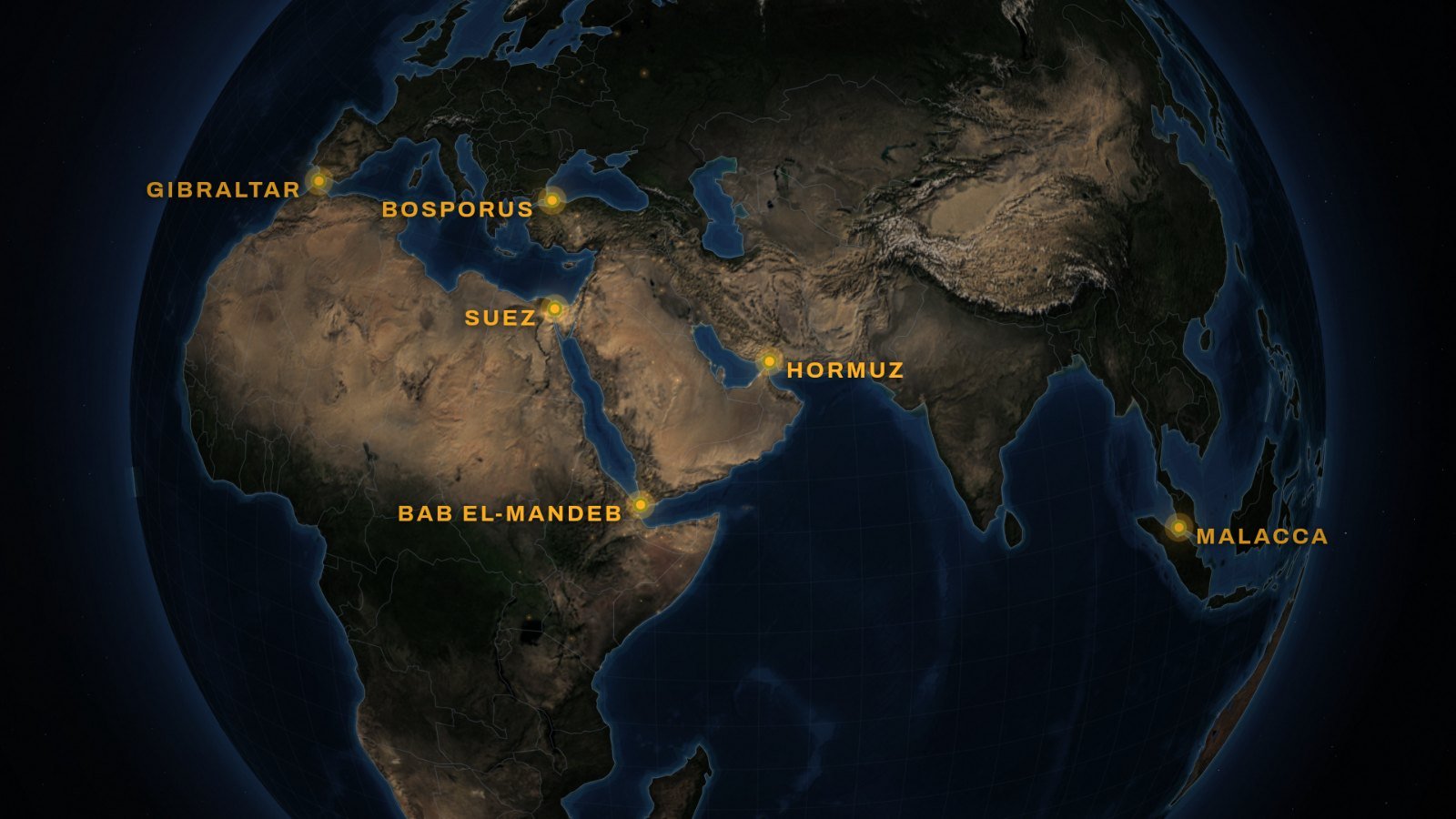
That is the logic of global trade chokepoints. A handful of narrow passages carry a large share of the world’s oil and goods, so trouble in one is felt everywhere. Which passages matter most, how much passes through each, who controls them, and what has gone wrong in each since 2021?
What are global trade chokepoints?
A chokepoint is a narrow passage on a busy sea route that ships cannot easily avoid. Four things decide how much one matters.
First, volume. The US Energy Information Administration (EIA) estimates that about 77.5 million barrels of oil a day moved by sea in 2023. That is roughly three-quarters of world supply.
Second, width. In a narrow channel, one grounded ship, one mine or one missile battery can stop traffic.
Third, the detour. Some chokepoints have a pipeline or a longer sea route around them. Others have nothing close.
Fourth, the shore. Global trade chokepoints fall into two families. Canals belong to the state that runs them, and earn tolls. Natural straits are lined by coastal states, and sometimes by armed groups. So the risk is not only closure: insurers raise premiums, lines reroute, and costs travel down supply chains.
World trade chokepoints compared: the key numbers
The table compares the main global trade chokepoints, using the latest figure found for each.
| Chokepoint | Connects | What passes (latest figure) | Who controls the shores | Disruption since 2021 |
|---|---|---|---|---|
| Strait of Hormuz | Persian Gulf and Gulf of Oman | 20 million barrels of oil a day (EIA, 2024) | Iran and Oman | Largely closed since 28 Feb 2026 |
| Strait of Malacca | Indian Ocean and South China Sea | About 24 million barrels a day, the largest flow (EIA, 2023) | Indonesia, Malaysia, Singapore | No closure |
| Bab el-Mandeb | Gulf of Aden and Red Sea | About 9 million barrels a day (EIA, 2023); more than halved in 2024 | Yemen; Djibouti and Eritrea | Houthi attacks since Nov 2023; Houthis take Yemen’s shore, Sep 2026 |
| Suez Canal (with the SUMED pipeline) | Red Sea and Mediterranean | 8.8 million barrels a day (EIA, 2023); over 26,000 ships in 2023 | Egypt (Suez Canal Authority) | Ever Given, 2021; transits halved in 2024 |
| Panama Canal | Atlantic and Pacific | 13,404 transits in the year to September 2025 | Panama (Panama Canal Authority) | Drought limits, 2023-24 |
| Turkish Straits | Black Sea and Mediterranean | Oil and grain from Black Sea ports | Turkey | Closed to warships, February 2022 |
| Danish Straits | Baltic Sea and North Sea | About 5 million barrels a day (EIA, 2023) | Denmark and Sweden | No closure |
Figures differ by source and year, so the dates matter. The EIA put Hormuz at 20.9 million barrels a day in 2023 and 20 million in 2024. The International Energy Agency also gives about 20 million, about a quarter of seaborne oil trade. This article uses the EIA where it can, because it publishes one consistent series. The EIA revised that series in March 2026, so the 2023 figures here are rounded.
Trade shares vary too. The Red Sea route normally carries about 12% of world trade, CNN reported in September 2026. UNCTAD, the UN trade body, estimated that 22% of seaborne container trade passed through Suez in 2023. For Panama, Reuters gives about 3% of seaborne trade, while other estimates reach 5%.
Hormuz and Malacca: the two great oil gates
Most Gulf oil heading east passes two gates: first Hormuz, then Malacca. Each carried about 20 million barrels a day or more before 2026.
The Strait of Hormuz
Hormuz is the only sea exit from the Persian Gulf. Iran lines its northern shore, and Oman’s Musandam peninsula the southern one. The strait is about 21 miles (33 km) wide at its narrowest. In 2024, its oil flow equalled about 20% of world petroleum consumption, according to the EIA.
Since the war began on 28 February 2026, Iran has kept the strait largely closed to normal traffic. There have been two short-lived openings. After a ceasefire in early April, Iran said on 18 April that it had closed the strait again, NPR reported. Traffic partly resumed after a US-Iran memorandum on 17 June, Al Jazeera reported, but it did not last.
Meanwhile, the United States has blockaded Iran’s own ports, from 13 April to 18 June and again since 14 July, CNBC reported. Iran’s seaborne crude exports fell to zero in September, Euronews reported. Brent crude peaked at $126.41 a barrel on 30 April.
October brought more attacks. Lloyd’s List counted 143 transits between 28 September and 7 October, USNI News reported, a small fraction of pre-war traffic. Iran’s Revolutionary Guard said a container ship sank after hitting a mine. However, Singapore said its sunken ship, the GFS Pride, had been hit by an unknown projectile. Two senior Iranian officials told Reuters that Iran is using new tactics to keep oil prices high and to influence the US midterm elections.
Iran says the strait stays closed until Washington meets its conditions. Saudi Arabia has worked around it. Its East-West pipeline ran at full capacity, and exports from Yanbu, on the Red Sea, rose towards 5 million barrels a day. Drone attacks shut the pipeline in September, but loadings resumed later that month. That moved the risk elsewhere. Our article on whether Iran can close the Strait of Hormuz goes deeper.
The Strait of Malacca
Malacca runs between the Malay Peninsula and the Indonesian island of Sumatra. It links the Indian Ocean to the South China Sea and the Pacific. At its narrowest, in the Phillips Channel near Singapore, it is about 1.7 miles (2.7 km) wide, according to the EIA.
By volume, the Strait of Malacca is the world’s biggest oil chokepoint: about 24 million barrels a day in 2023, the EIA estimates. It is the main route between the Gulf and the big Asian importers: China, Japan and South Korea. Indonesia, Malaysia and Singapore share its waters, and no country charges a toll for passing.
For China, this is a long-standing strategic worry, because much of its imported oil arrives this way. Ships leaving Malacca enter the South China Sea, where China’s claims are disputed by its neighbours.
Bab el-Mandeb and the Suez Canal: the Red Sea route
The shortest sea route between Asia and Europe has two gates. A ship enters the Red Sea through Bab el-Mandeb in the south and leaves through the Suez Canal in the north. The alternative is the long way around Africa’s Cape of Good Hope.
Bab el-Mandeb
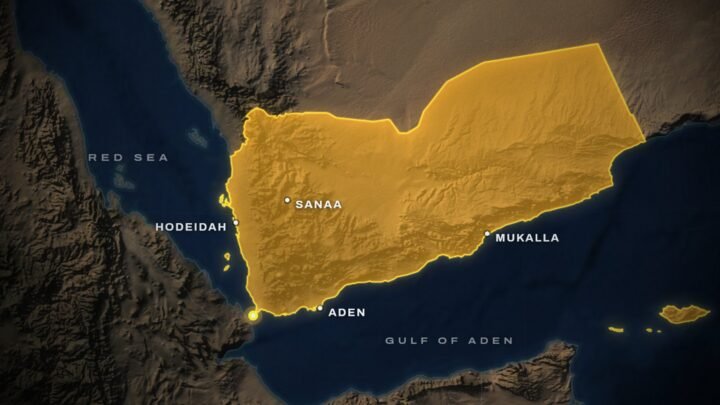
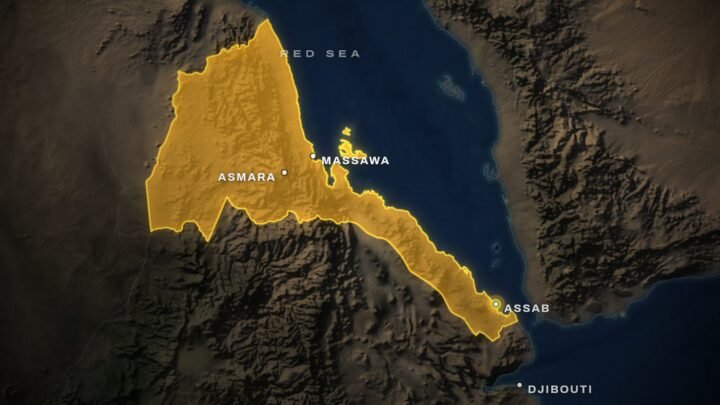
Bab el-Mandeb lies between Yemen on one side and Djibouti and Eritrea on the other. The EIA gives its width as 18 miles (29 km) at the narrowest point. CNN and Al Jazeera report about 32 km, because the figure depends on where it is measured. In 2023, about 9 million barrels of oil a day passed through it.
In November 2023, Yemen’s Houthi movement seized the cargo ship Galaxy Leader and began attacking shipping, AP reported. By early 2025, according to AP, the Houthis had targeted more than 100 merchant ships, sinking two and killing four sailors. Oil flows through the strait fell by more than half in the first eight months of 2024, the EIA found. A US air campaign in 2025 ended with an Oman-brokered ceasefire in May.
In 2026 the strait became more important, not less, because Saudi oil now leaves through the Red Sea. On 20 July, the Houthis declared a blockade of Saudi-linked shipping, CNBC reported. On 11 August, a Houthi attack on the ship Tihamah killed six people, Yemen’s government said. In September, the Houthis took the port of Mokha and Perim island in the strait itself, Al Jazeera reported.
Then, in early October, a Saudi-backed government offensive began. The government said it had retaken Mokha, but the Houthis denied losing ground, and the claim had not been independently confirmed. Our articles on why nobody can conquer Yemen, why everyone suddenly wants Eritrea and why Israel wants a base in Somaliland explain the struggle for this coast.
The Suez Canal
Egypt’s Suez Canal opened in 1869 and is run by the Suez Canal Authority. Together with the SUMED pipeline beside it, it carried about 8.8 million barrels of oil a day in 2023.
On 23 March 2021, the container ship Ever Given ran aground and blocked the canal for six days. The blockage held up some $9 billion of trade each day, according to the academic site Port Economics, Management and Policy. More than 400 ships queued at both ends.
The Red Sea attacks did far more lasting damage. By early 2024, Suez transits were down 42% from their peak, UNCTAD estimated, and weekly container ship transits were down 67%. The canal handled 13,213 ships in 2024, against more than 26,000 in 2023, the canal authority said. Its revenue fell from a record $10.25 billion to $3.99 billion.
Now the Hormuz crisis is pushing traffic back. In July 2026, 1,340 ships crossed, 27% more than a year earlier, and revenue rose 42%, Bloomberg reported. The canal’s chairman expects $5.8 billion to $6 billion for 2026, up from $4.1 billion in 2025. That is still well below the 2023 record.
The Panama Canal: a chokepoint that runs on rain
The Panama Canal links the Atlantic and the Pacific, and it is run by the Panama Canal Authority. Unlike Suez, it lifts ships through locks filled with fresh water from rain-fed lakes. So, of all the global trade chokepoints, it is the one most exposed to the weather.
In 2023, a drought hit the canal’s watershed. The authority cut daily booking slots to 24 in November 2023 and 22 in December, The Waterways Journal reported. By early 2024, transits were down 49% from their peak, UNCTAD estimated. As the rains returned, the canal recovered: 13,404 transits in the year to September 2025, up 19.3%, with revenue of about $5.7 billion, Baird Maritime reported from the canal’s figures.
In 2026, the Hormuz closure sent more ships to Panama. Between October 2025 and June 2026, the canal handled 10,726 transits, an average of 35 a day, the Panama Canal Authority said. Traffic peaked at 40 to 41 ships a day during the closure, FreshPlaza reported. Now an expected El Niño threatens new capacity limits.
It is a political chokepoint too: in January 2026, Panama’s Supreme Court annulled a Hong Kong company’s concession for two ports at its entrances, CNN reported. Our article on why Trump wants the Panama Canal covers that fight.
The Turkish and Danish Straits: Europe’s sea gates
The Turkish Straits
The Bosporus and the Dardanelles link the Black Sea to the Mediterranean through the Sea of Marmara. The Bosporus runs through Istanbul and is less than 1 km wide at its narrowest. Oil and grain from Russia, Kazakhstan and Ukraine pass this way.
Turkey controls both shores. The 1936 Montreux Convention guarantees merchant ships free passage in peacetime but lets Turkey limit warships. In February 2022, after Russia’s full-scale invasion of Ukraine, Turkey invoked it to close the straits to warships. Ships returning to their home bases in the Black Sea were exempt.
The Danish Straits
The Danish Straits, the Øresund and the Great and Little Belts, link the Baltic Sea to the North Sea. They carried about 5 million barrels of oil a day in 2023, the EIA estimates, much of it Russian exports from Baltic ports.
Denmark and Sweden line these waters, and both are now NATO members. That matters for Russia’s Baltic exports and for Russia’s exclave of Kaliningrad. Our article on why Sweden joined NATO explains what that change meant for the Baltic.
Other narrow seas matter too, such as the Strait of Gibraltar and the Taiwan Strait, about 130 km wide (see why China wants Taiwan). There is more analysis of global affairs on the region page.
What to watch next
Four things will decide how the global trade chokepoints behave over the coming months.
- Hormuz talks. A US-Iran deal would reopen the strait. Meanwhile, a US official has said the US could have three aircraft carriers around Iran by the end of November.
- The battle for Yemen’s coast. Whoever holds Mokha and Perim can threaten Bab el-Mandeb. Watch whether the Houthis strike tankers leaving Yanbu, now Saudi Arabia’s main outlet.
- Rain in Panama. If El Niño brings another drought, the canal may have to limit transits again, just as demand is high.
- Suez’s recovery. The canal authority’s forecast of up to $6 billion for 2026 depends on the Red Sea staying passable.
Frequently asked questions
What are the main chokepoints in the world?
The main global trade chokepoints are the Strait of Hormuz, the Strait of Malacca, Bab el-Mandeb, the Suez Canal, the Panama Canal, the Turkish Straits and the Danish Straits. By oil volume, Malacca is the largest, at about 24 million barrels a day in 2023, followed by Hormuz, according to the US Energy Information Administration.
What does chokepoint mean in trade?
In trade, a chokepoint is a narrow passage on a major shipping route, such as a strait or a canal, that ships cannot easily avoid. Because so much cargo funnels through it, a closure, an accident or an attack there can delay shipments, raise freight and insurance costs, and push up prices far away.
Is the Strait of Hormuz open or closed?
As of 16 October 2026, the Strait of Hormuz is largely closed to normal traffic. Iran has restricted it since US and Israeli strikes began on 28 February 2026, apart from short-lived openings in April and June. Iran says it will stay closed until the United States meets its conditions, and attacks on ships rose in October.
Is the Bab el-Mandeb strait closed?
Bab el-Mandeb is open but dangerous. The Houthis declared a blockade of Saudi-linked shipping in July 2026 and took Yemen’s coast at the strait in September. Ships still pass, but fewer than before November 2023, when Houthi attacks began. A Saudi-backed offensive to retake the coast started in early October 2026.
Who controls the Strait of Malacca?
No single country controls the Strait of Malacca. Indonesia, Malaysia and Singapore share its waters, and no state charges ships a toll to pass. It is the world’s busiest oil chokepoint, carrying about 24 million barrels a day in 2023, mostly between the Gulf and the big importers of East Asia.
Sources
- World Oil Transit Chokepoints
- World Oil Transit Chokepoints (updated edition)
- Amid regional conflict, the Strait of Hormuz remains critical oil chokepoint
- Strait of Hormuz
- Bab el-Mandeb Strait (Today in Energy)
- Red Sea attacks and oil flows through Bab el-Mandeb (Today in Energy)
- Two ships sink near Hormuz after being hit by projectiles amid surge in attacks
- Container ship sank after hitting naval mine in Hormuz: Iran Guards
Show all 45 sources
- October sees near-daily strikes on ships in Hormuz
- Iran says Strait of Hormuz to remain closed until US meets conditions
- Iran insists it controls Hormuz as rial hits record low and exports dry up
- US Navy blockade of Iran's oil exports
- Strait of Hormuz: What has happened since the US-Iran MoU on June 17?
- Iran says it has closed the Strait of Hormuz again, as ceasefire nears its end
- Oil prices hit wartime high
- Saudi East-West pipeline at full capacity
- Houthi rebels release crew of Galaxy Leader ship seized in Red Sea in November 2023
- Egypt's revenue from the Suez Canal plunged sharply in 2024
- Trump: US halting military campaign against the Houthis
- Houthis deploy missiles and drones to attack ships in southern Red Sea, naval group says
- Six killed in Houthi attack on Bab al-Mandeb ship, Yemen's government says
- Houthis control key shipping route after gains along Yemen's Red Sea coast
- What the Houthis' grip on Bab al-Mandeb means for the global economy
- Iran war, Yemen, Saudi Arabia and Mokha
- UNCTAD raises concerns over Red Sea, Black Sea and Panama Canal disruption
- UNCTAD raises alarm over disruptions in shipping routes for global trade
- Suez Canal revival gathers pace as Hormuz crisis reroutes ships
- Blockage of the Suez Canal, March 2021
- How did the Suez Canal blockage back up shipping for months?
- Panama Canal restrictions extended, deepened
- Panama Canal revenue hits $5.7b in FY2025 as traffic surges
- Panama Canal reports higher transits and tonnage while preparing to meet demand amid expected El Niño conditions
- Panama Canal expects revenue to exceed US$5.2 billion forecast
- Panama Canal transits up 5.2% as El Niño capacity restrictions loom
- CK Hutchison will not sign deal to sell strategic Panama ports next week, sources say
- Hong Kong company's concession to operate Panama Canal ports is ruled unconstitutional
- Part 1: Key Facts on Strait of Hormuz
- Straits of Hormuz traffic separation scheme keeps within Omani waters
- The Taiwan Strait: crucial waterway and military flashpoint
- Sweden joins NATO as 32nd Alliance member
- The Baltic Sea is far from a NATO lake
- U.S. deploys third aircraft carrier to Middle East as war with Iran enters eighth month
- Turkey closes Bosphorus, Dardanelles straits to warships
- Saudi Arabia ramps Yanbu exports toward 5 MMbpd as Hormuz disruption forces rerouting
- Saudi resumes Yanbu oil loading after pipeline restart
Facts as of 16 October 2026. Spotted a mistake? Tell us, and we will correct it.