Africa Analysis Episode 15
Why Everyone Suddenly Wants Eritrea
Eritrea is one of the most closed countries on earth. Yet within weeks Washington lifted its sanctions, Ethiopia broke off relations and Egypt drew it into a new bloc. The reason is on the map: more than 1,000 km of Red Sea coast.

In short
- Eritrea has more than 1,100 km of mainland Red Sea coast, running down to the Bab el-Mandeb strait; its port of Assab is about 65 km from Yemen's Mokha.
- Ethiopia lost its coast when Eritrea became independent in 1993 and now sends more than 90% of its trade through Djibouti; Abiy Ahmed calls sea access existential.
- The United States lifted its sanctions on Eritrea's ruling party and army on 18 September 2026; Ethiopia and Eritrea cut ties on 1 October.
- On 4 October 2026, Eritrea, Egypt, Somalia and Sudan signed the Alamein Declaration, which says Red Sea security belongs to the coastal states alone.
- In October 2026, Ethiopia told the UN that Eritrean troops had entered Tigray; Eritrea denies it and accuses Ethiopia of declaring war.
In this analysis 8 sections
- 01What kind of country is Eritrea?
- 02Why does Eritrea's Red Sea coast matter?
- 03Why does Ethiopia want the port of Assab?
- 04Eritrea Ethiopia war: how close are they?
- 05Why are Egypt, the Gulf and Washington courting Eritrea?
- 06A coast for hire? Who has used Eritrea's ports before
- 07What to watch next
- 08Frequently asked questions
On 18 September 2026, Washington lifted its sanctions on Eritrea’s ruling party and army. On 1 October, Ethiopia closed its embassy in Asmara, and Eritrea cut all ties. Three days later, Eritrea’s president signed a joint declaration with the leaders of Egypt, Somalia and Sudan.
Eritrea has never held a national election, and its constitution was never put into force. Yet it holds more than 1,000 km of Red Sea coast beside one of the world’s busiest straits. So why does everyone suddenly want Eritrea, and could the fight over its coast start a war?
What kind of country is Eritrea?
In 1993, Eritreans voted for independence from Ethiopia, with 99.8% voting yes. The man who led the war for it, Isaias Afwerki, has run the country since 1991. He turned 80 in February 2026.
A constitution was ratified in 1997, but it has never been put into force. There has been no national election since independence. The National Assembly has not met since 2002, and one party, the People’s Front for Democracy and Justice, rules.
In 2001, the government shut every private newspaper and jailed its critics, including senior officials and journalists. Twenty-five years later, none of them has been charged or tried, and the government will not say whether they are alive. Reporters Without Borders ranked it last of 180 countries for press freedom in 2026.
By law, national service lasts 18 months. In practice, Human Rights Watch says, most conscripts serve for years and some for decades. Meanwhile, more than 679,000 Eritreans are refugees or asylum seekers abroad, according to the UN refugee agency. That is from a population of about 3.7 million, by the UN’s estimate; no census has ever been published.
In June 2026, a UN expert said there are still reasonable grounds to believe crimes against humanity continue. Asmara called his report “fundamentally flawed”. It says long national service is the price of defending itself after Ethiopia’s “war of aggression” in 1998.
Some reporters call Eritrea “the North Korea of Africa”. Others say the label misleads. So why would anyone court a state like this?
Why does Eritrea’s Red Sea coast matter?
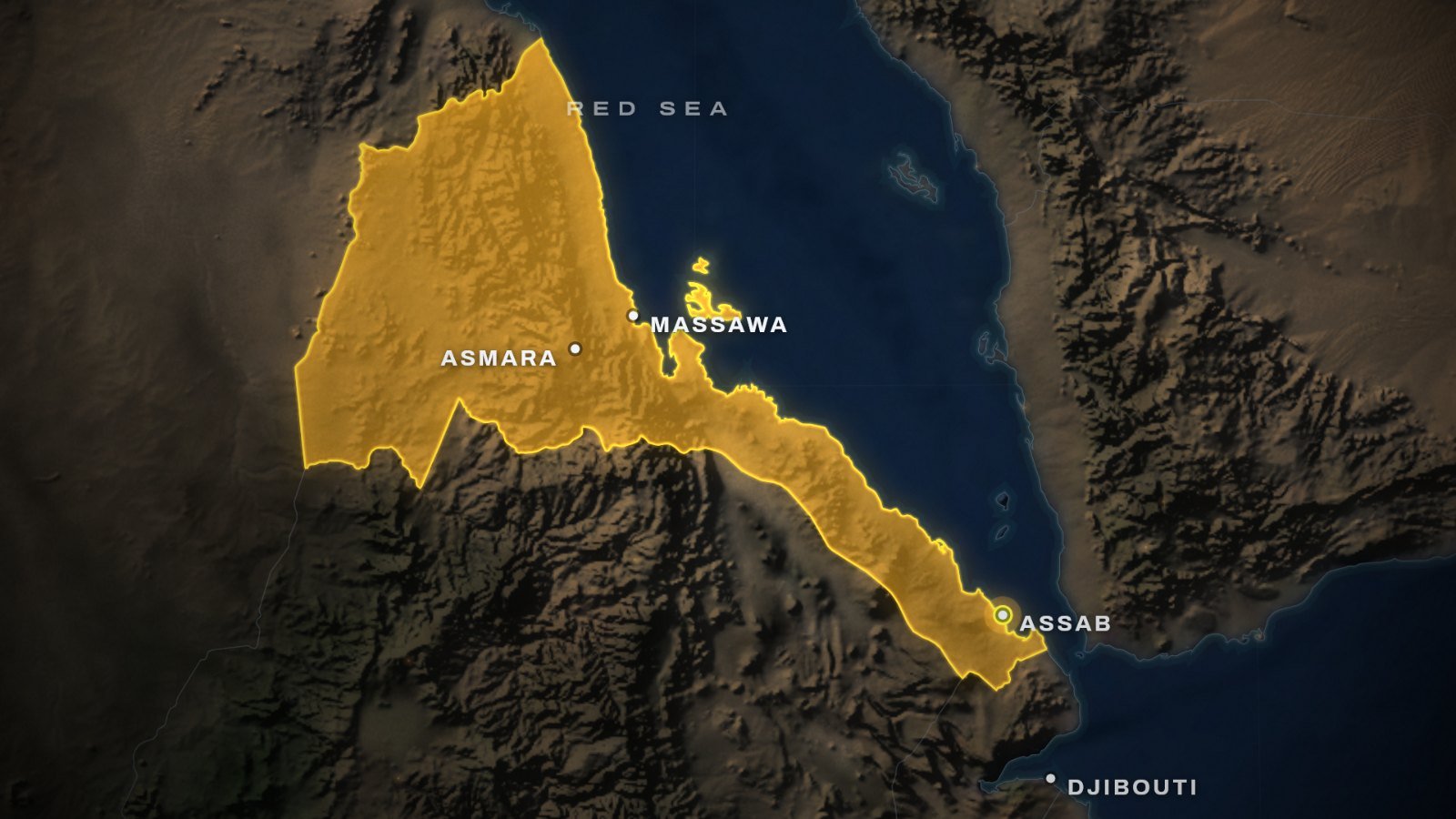
Look at the map. Eritrea has 1,151 km of mainland coast, and 2,234 km counting its islands, among them the Dahlak archipelago. It holds the African shore of the southern Red Sea, all the way down to the Bab el-Mandeb strait. At the far southern end lies Ras Doumeira, a headland on the border with Djibouti whose ownership is disputed.
The Bab el-Mandeb is about 30 km wide at its narrowest. In normal times, about 12% of world trade passes through it. Since late 2023, however, Houthi attacks from Yemen have cut that traffic sharply.
In 2026, the pressure grew. Since the United States and Israel went to war with Iran in February, the Strait of Hormuz has been largely shut. Then, in September, the Houthis took the Yemeni port of Mokha and the Hanish islands that face Eritrea. Eritrea’s port of Assab sits about 65 km across the water from Mokha.
In early October, Saudi-backed Yemeni forces struck back and said they had retaken Mokha. The Houthis have not confirmed it. Either way, the Eritrean shore suddenly looks like the calmer side of the Red Sea. Reuters described Asmara as looking “to come in from the cold”. For the battle on the other shore, see why nobody can conquer Yemen.
| Key numbers | Figure |
|---|---|
| Mainland coastline | 1,151 km |
| Coastline including islands | 2,234 km |
| Width of the Bab el-Mandeb at its narrowest | about 30 km |
| Share of world trade through the strait in normal times | about 12% |
| Assab to Mokha, Yemen | about 65 km |
| Assab to the strait | about 80 km |
| Population | about 3.7 million (UN estimate; no census published) |
| Eritrean refugees and asylum seekers abroad | more than 679,000 (December 2025) |
| Ethiopia’s trade through Djibouti | more than 90%, at an estimated $1.5bn a year |
| Deaths in the 1998-2000 border war | about 70,000 to 100,000 (estimates) |
| Runway the UAE used at Assab | about 3,500 m |
But nobody wants that shore more than the big neighbour inland.
Why does Ethiopia want the port of Assab?
When Eritrea became independent in 1993, Ethiopia lost its coast. Until 1998, most of Ethiopia’s trade still went through Assab.
Then a border war broke out over a small town called Badme. Somewhere between 70,000 and 100,000 people died. In 2002, an international commission ruled on the border and later placed Badme in Eritrea. Ethiopia accepted the ruling in full only in 2018.
That year, Ethiopia’s new prime minister, Abiy Ahmed, made peace with Isaias, and he won the Nobel Peace Prize in 2019. In 2020, Eritrea’s army even fought beside Ethiopia’s in Tigray. UN investigators and Amnesty International accuse it of grave abuses there. Asmara rejects the accusations.
Today, more than 90% of Ethiopia’s trade goes through Djibouti, at an estimated cost of about $1.5bn a year. In October 2023, Abiy called sea access existential for a population heading towards 150 million.
A population of 150 million can’t live in a geographic prison.
Abiy Ahmed, Ethiopia’s prime minister, October 2023
Abiy says Ethiopia will not fire a single bullet at its neighbours. But in February 2026, Ethiopia demanded that Eritrean troops leave its territory. It also offered talks that included access to the sea through Assab. Asmara called the claims “false and fabricated”. It says using a port is a matter of commercial deals, not of sovereignty.
On 5 October 2026, sworn in for a new term, Abiy promised a way to the sea through “give and take”. Two days later, Eritrea’s information minister accused Ethiopia’s ruling party of preparing a military push for the sea. He cited remarks attributed to a senior Ethiopian general that named Assab; Dawan, which reported them, could not verify the remarks.
Eritrea Ethiopia war: how close are they?
They are not formally at war, as of 16 October 2026. But each side now accuses the other of starting one. The full story of Ethiopia’s internal fighting is in Ethiopia war explained; here is the part that involves Eritrea.
In late September, Ethiopia’s army chief accused Eritrea, Egypt and Sudan of backing the rebels fighting his government. All three deny it. On 1 October, Ethiopia expelled 10 Eritrean diplomats, and Eritrea cut ties. On 3 October, the US State Department urged both countries to “exercise maximum restraint”.
The quarrel then reached the UN. On 7 October, witnesses told Reuters they saw Eritrean soldiers in Adigrat, inside Ethiopia’s Tigray region. Ethiopia told the UN Security Council that Eritrean troops had advanced up to 60 km into Tigray, and said it was acting in self-defence.
Asmara denies any incursion. In its own letter to the Council, it called Ethiopia’s message a “declaration of war”. It accused Ethiopia of seeking “sovereign access to the sea” by force and asked the Council to act. Reuters could not independently verify the reported incursion.
On the ground, Ethiopian forces moved back into Adigrat on 10 October and reached Zalambessa, on the border, on 13 October, according to Reuters. A pro-government militia claims Eritrean troops suffered heavy losses; Asmara rejects that. On 13 October, the International Crisis Group warned that the two countries were close to all-out war. It added that a direct war could spread along Eritrea’s Red Sea coast.
Why are Egypt, the Gulf and Washington courting Eritrea?
Egypt and the Nile
Egypt’s motive is water. In September 2025, Ethiopia opened its giant dam on the Blue Nile. Egypt gets almost all of its fresh water from the Nile, and its president warns of an existential threat to that water.
So Cairo has built friendships around Ethiopia. It signed a defence pact with Somalia in August 2024 and held summits with Eritrea. In May 2026, Egypt and Eritrea signed a maritime transport agreement. Egypt has also reportedly agreed to upgrade the port of Assab, with berths for warships; neither government has confirmed it.
On 4 October 2026, at El Alamein, Egypt, Eritrea, Somalia and Sudan signed a joint declaration. It calls Red Sea security “the exclusive responsibility of littoral states”. Ethiopia is not one of them. The declaration also rejects one-sided moves that harm Egypt’s and Sudan’s use of the Nile.
Ethiopia answered the next day without naming the summit. It supplies most of the Nile’s water, it said, and it “stands ready to defend its sovereignty”.
The Gulf splits
Meanwhile, the Gulf is divided over the Horn. The UAE declared “full solidarity” with Ethiopia’s government in September. Egypt and Saudi Arabia, by contrast, court Eritrea. Somalia’s own alliances, with Turkey and against Israel’s move in Somaliland, are explained in why Turkey wants Somalia and why Israel wants a base in Somaliland.
Washington’s U-turn
The United States sanctioned Eritrea’s ruling party, army and party businesses in 2021, over the Tigray war. In September 2026, the order expired, and the US Treasury struck the names off its list. A State Department official said it was “time to adapt our foreign policy to current realities”. Many reports link the move to the Red Sea and to the Houthis on the other shore. The information minister in Asmara welcomed “the gesture”.
A coast for hire? Who has used Eritrea’s ports before
This is not the first time outsiders have courted this coast. In the late 1970s and the 1980s, the Soviet navy used Nokra, in the Dahlak islands, then held by Ethiopia. It kept an anchorage and a small marine unit there. In 2008, Iran was reported to have won access to Assab’s idle refinery; Eritrea denied hosting Iranian forces.
In 2015, the United Arab Emirates leased Assab’s port and airfield for 30 years. It built a base there for the war in Yemen, with a runway of about 3,500 m. By 2021, satellite images showed parts of it being taken apart.
Russia came next. Its foreign minister toured the port of Massawa in 2023, and in 2024 a Russian warship called there, the first since Soviet times. Meanwhile, China buys most of what Eritrea sells abroad: zinc and copper, from mines such as Bisha, which a Chinese company part-owns.
Eritrea’s foreign minister now accuses the UAE of “port imperialism”. In an interview in September 2026, he said: “We do not want any foreign power to have a ‘hub’ in Eritrea.”
What Eritrea and its rivals say they want
Eritrea says it wants its sovereignty respected, no foreign bases on its soil and the Red Sea left to the states on its shores. It says Ethiopia blames its neighbours to distract from problems at home. Ethiopia says a country of more than 120 million people cannot stay locked out of the sea, and promises to get there without war. Egypt wants no more dams on the Nile. Washington wants a quiet strait.
What to watch next
Who comes after Isaias Afwerki?
One question hangs over everything: who comes after Isaias? He is 80. There is no vice-president, no named successor and no constitution in force to say what happens. Analysts point to his security chief, his top political adviser and his army chief. One report says he has sought support for his son.
So watch four things:
- The border and the front near Assab. Fighting around Zalambessa or in Afar would show whether the quarrel becomes a war between states.
- The islands at the strait. Whoever holds the Yemeni shore and the Hanish islands decides how safe Eritrea’s coast really is.
- The UN Security Council. Both sides have asked it to act; what it says will shape the risk of escalation.
- Who stands beside Isaias. A sudden succession would change every deal on this coast.
For more on the region, read more analysis on Africa.
Frequently asked questions
Why is Eritrea called the North Korea of Africa?
Some reporters use the label because Eritrea has never held a national election, has had no private press since 2001 and keeps many conscripts in national service for years. Other analysts say the label misleads. Eritrea’s government calls such criticism a smear campaign and says it is defending its sovereignty.
Is Eritrea at war with Ethiopia?
Not formally, as of 16 October 2026. The two cut diplomatic ties on 1 October. Ethiopia then told the UN Security Council that Eritrean troops had entered Tigray and said it was acting in self-defence. Eritrea denies any incursion and calls Ethiopia’s letter a declaration of war.
Why does Ethiopia want Assab?
Ethiopia has been landlocked since Eritrea’s independence in 1993. Before the 1998 war, most of its trade went through Assab. Today more than 90% goes through Djibouti, at an estimated $1.5bn a year. Abiy Ahmed calls sea access existential, but says he wants it through talks, not war.
Who is the president of Eritrea?
Isaias Afwerki has led Eritrea since 1991 and has been president since independence in 1993. He led the independence war against Ethiopia. Born in February 1946, he turned 80 in 2026. Eritrea has no vice-president, no named successor and no constitution in force to set out a succession.
What is the population of Eritrea?
The UN estimates Eritrea’s population at about 3.7 million people. Eritrea has never published a census, so the figure is uncertain, and other estimates are higher. More than 679,000 Eritreans live abroad as refugees or asylum seekers, according to the UN refugee agency’s count for December 2025.
Sources
- Ethiopian forces expand control in Tigray as militia claims Eritrean losses
- Ethiopian troops enter town on border with Eritrea, stoking war fears
- Pulling Ethiopia and Eritrea Back from War
- Ethiopia war security review, 13 October 2026
- Eritrea urges UN deterrence measures against Ethiopia
- Eritrea urges UN to intervene in standoff with Ethiopia
- Ethiopian forces regain control of border city after reported Eritrean incursion
- Ethiopia and Eritrea accuse one another of launching war
Show all 59 sources
- Witnesses spot Eritrean troops inside northern Ethiopia as tensions flare
- Eritrea accuses Ethiopia of planning war to gain Red Sea access
- As Iran war smoulders, shunned Eritrea looks to come in from the cold
- Ethiopia's PM insists on access to Red Sea despite regional conflict threat
- Ethiopia's reply to the Alamein Declaration
- Yemeni government forces say Bab el-Mandeb strait secured
- Alamein Declaration: Egypt, Eritrea, Sudan and Somalia forge unified front on Red Sea governance
- Yemen: Saudi-backed counter-offensive against the Houthis
- U.S. statement on increased tensions between Ethiopia and Eritrea
- Eritrea severs diplomatic ties with Ethiopia in tit-for-tat move
- Red Sea brief, 1 October 2026
- Egypt seeks greater share of Nile water amid rising tension with Ethiopia
- Qatar and UAE back Ethiopian government as fighting spreads beyond Tigray
- Ethiopia blames regional rivals as risk of conflict spillover rises
- Notice of OFAC sanctions action
- US lifts Eritrea sanctions imposed over Ethiopian war to advance regional interests
- US lifts sanctions targeting Eritrea's ruling party and the military
- Eritrea's foreign minister says UAE pursuing 'port imperialism' across Africa
- Houthis seize Yemen's entire western coast and strategic Red Sea islands
- Bab al-Mandeb strait: the Houthis and the global economy
- No signs of meaningful improvement in Eritrea's human rights situation, warns UN expert
- Statement by Ambassador Sophia Tesfamariam, Geneva
- Egypt, Eritrea sign agreement for cooperation in maritime transport
- UNHCR position on Eritrean refugees and asylum seekers
- World Press Freedom Index 2026: Africa
- Eritrea: Freedom in the World 2026
- World Report 2026: Eritrea
- Abiy Ahmed insists Ethiopia will not go to war over sea access
- Ethiopia demands Eritrea immediately withdraw troops from its territory
- Eritrea rejects Ethiopian claims of troops operating inside its borders
- Eritrea rejects Ethiopia's sovereign sea access
- Egypt increases pressure on Ethiopia through port deals with Eritrea and Djibouti
- Nile basin crisis: GERD inauguration sparks new existential feud
- A population of 150 million can't live in a geographic prison: PM Abiy Ahmed
- Somalia, Eritrea and Egypt pledge to bolster security ties
- Russian warship's call at Massawa
- Eritrean soldiers committed war crimes and possible crimes against humanity in Tigray after the agreement to end hostilities
- All the president's men: Isaias Afwerki's close circle
- Eritrea country report
- UAE dismantles Eritrea base as it pulls back after Yemen war
- Eritrea joins the Belt and Road Initiative
- The new scramble for Africa (the UAE at Assab)
- Eritrea-Iran foreign relations
- UN inquiry finds crimes against humanity in Eritrea
- Dahlak Archipelago (the Soviet anchorage at Nokra)
- Ethiopia-Eritrea Boundary Commission (case 99)
- Eritrea's constitution (1997), never implemented
- Eritrea: 99.8% vote yes, 98% voter turnout
- Is Eritrea the North Korea of Africa?
- How the press covers Eritrea
- Eritrea: coastline (CIA World Factbook data)
Facts as of 16 October 2026. Spotted a mistake? Tell us, and we will correct it.