Middle East Analysis
Can Iran Close the Strait of Hormuz?
Before 2026, a fifth of the world's oil passed through one narrow channel off Iran's coast. Since the war began in February, Iran has largely shut it. How did it do it, what can get around it, and can it last?

In short
- In 2024, about 20 million barrels of oil a day passed through the Strait of Hormuz, about a fifth of world consumption, plus about a fifth of global LNG trade.
- The strait is about 33 km wide at its narrowest point, but each shipping lane is only about 3 km wide, and both lanes there lie in Oman's waters.
- Since US and Israeli strikes on Iran began on 28 February 2026, Iran has declared the strait closed, attacked ships and let through only vessels it approves.
- Saudi Arabia's East-West pipeline and the UAE's line to Fujairah can carry some oil around the strait, but far less than it normally handles.
- As of 16 October 2026, Iran says the strait remains closed and attacks on ships have surged, while the US keeps a naval blockade of Iran's ports.
In this analysis 8 sections
- 01Where is the Strait of Hormuz, and how narrow is it?
- 02How much oil and gas passes through the Strait of Hormuz?
- 03How could Iran close the Strait of Hormuz?
- 04What has happened in the Strait of Hormuz since February 2026?
- 05Can oil bypass the Strait of Hormuz?
- 06Can Iran close the Strait of Hormuz legally?
- 07What to watch next in the Strait of Hormuz
- 08Frequently asked questions
On 14 October 2026, Iran’s Revolutionary Guard said a container ship had sunk after hitting a naval mine in the Strait of Hormuz. Singapore said its ship GFS Pride sank after an unknown projectile hit it; it was unclear if both accounts meant the same vessel. The next day, a senior Iranian army official told state media that the strait remained closed, and that any passage must be coordinated with Iranian forces.
Before the war, about a fifth of the world’s oil passed through this one channel. So can Iran close the Strait of Hormuz? In practice, it has largely done so for most of 2026. The harder questions are how, at what cost, for how long, and whether the law allows it.
Where is the Strait of Hormuz, and how narrow is it?
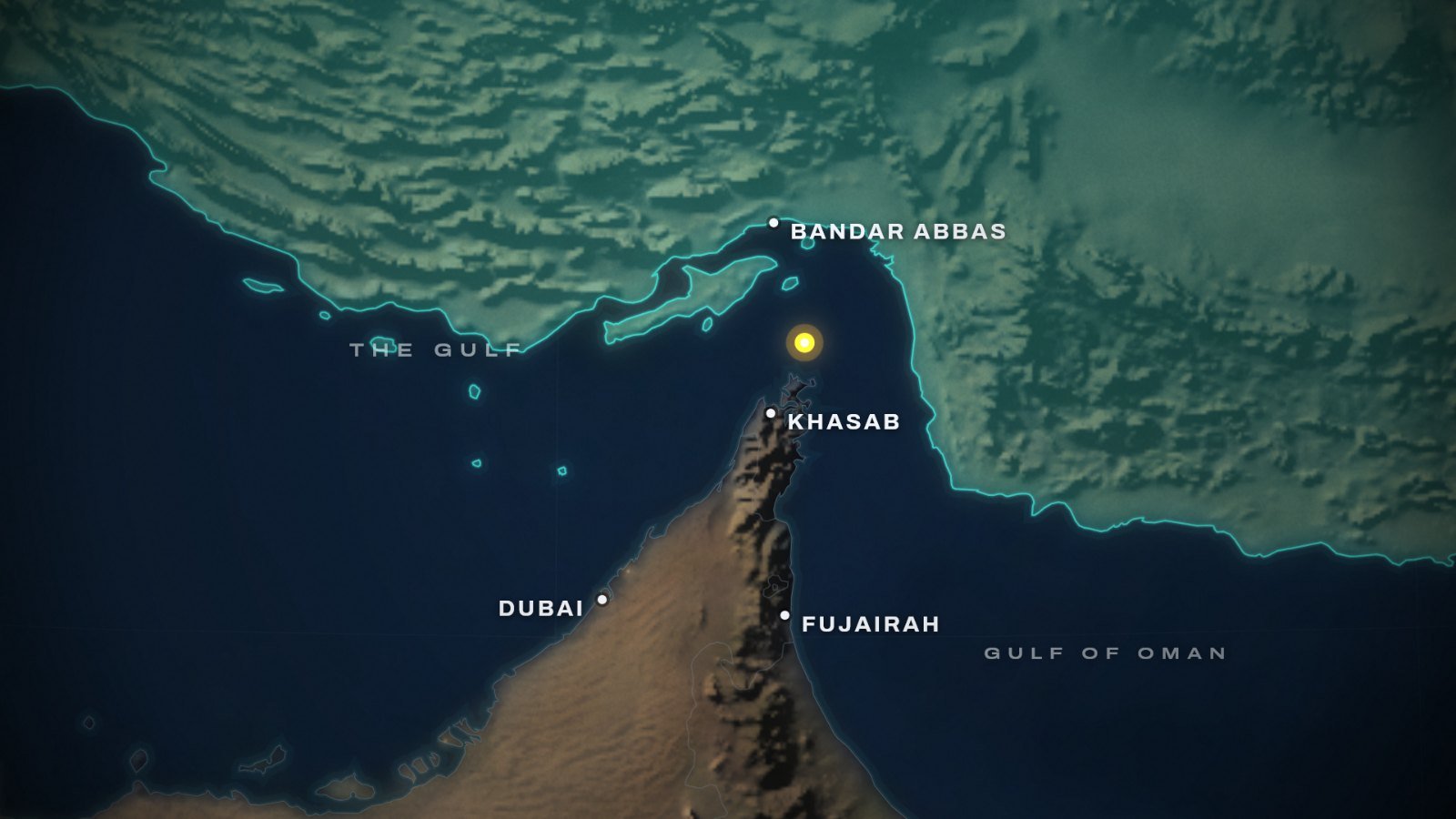
The strait links the Persian Gulf with the Gulf of Oman and the open ocean. Iran lies along its northern shore. On the southern side is Musandam, a peninsula that belongs to Oman.
According to figures from the US Energy Information Administration, the strait is about 21 miles, or 33 km, wide at its narrowest point. Yet each shipping lane is only about 2 miles, or 3 km, wide. A 2-mile buffer separates the two. The water is deep enough for the world’s largest crude tankers.
Those lanes follow a traffic scheme adopted by the UN’s shipping agency in 1968. At the narrowest point, both the inbound and the outbound lane lie in Oman’s waters, not Iran’s. That matters for the law, as we explain below.
Iran’s side is lined with islands, including Qeshm and Larak. In April 2026, Iran published its own traffic scheme. It sends inbound ships between Qeshm and Larak. Outbound ships pass just south of Larak, inside Iranian waters and within easy reach of its patrol boats.
So the map gives Iran an advantage. Every ship entering or leaving the Gulf passes within easy reach of its coast and islands.
How much oil and gas passes through the Strait of Hormuz?
The EIA calls the strait the world’s most important oil transit chokepoint. Its figures show that oil flows through the strait averaged about 20 million barrels a day in 2024, about 20% of world consumption. Most of it went east. Asia took 84% of the crude and condensate, led by China, India, Japan and South Korea.
Gas matters too. According to the EIA, about 20% of global trade in liquefied natural gas (LNG) passed through the strait in 2024. Almost all of it came from Qatar and the UAE.
| Key numbers | Figure | Source and year |
|---|---|---|
| Oil through the strait | About 20 million barrels a day (about 20% of world use) | EIA, 2024 |
| LNG through the strait | About 20% of world LNG trade | EIA, 2024 |
| Ship transits, June 2025 | 3,131 | Lloyd’s List, via USNI News |
| Ship transits, June 2026 | At least 576 | Lloyd’s List, via USNI News |
| Saudi East-West pipeline | 7 million barrels a day, at full capacity (March 2026) | Bloomberg |
| UAE Habshan-Fujairah pipeline | 1.5 to 1.8 million barrels a day | Seatrade; Reuters |
| Emergency oil release | 400 million barrels, the IEA’s largest ever (March 2026) | IEA, via Enerdata |
| Brent crude | About $70 before the war; briefly above $126 on 30 April 2026 | AP; Keystone-SDA |
How could Iran close the Strait of Hormuz?
Iran does not need to block the water physically. It needs shipowners, crews and insurers to believe that passage is too dangerous. It has several tools for that.
Mines
Iran used mines against tankers in the 1980s, and they remain central to its strategy. According to the Congressional Research Service, as cited by the Stimson Center, Iran holds an estimated 5,000 to 6,000 naval mines. A declassified CIA report from 2009, quoted by the Stimson Center, summed up the thinking:
Iran “has adopted a strategy in which a few mines or the threat of mining would be used to deter shipping.”
US Central Intelligence Agency report, 2009 (declassified)
In March 2026, reports of Iranian mining varied. US officials told the Wall Street Journal that Iran had laid fewer than 10 mines; sources told Reuters about a dozen. On 10 March, US Central Command said it had destroyed 16 Iranian minelaying vessels. Yet on 13 March, the US defence secretary said there was no clear evidence that Iran had actually laid mines. Later, the Critical Threats Project reported that on 30 August Iran used missile launchers, rather than boats, to lay mines.
Fast boats and missiles
US military assessments describe a Revolutionary Guard navy trained for hit-and-run attacks on larger ships. It would use swarms of small boats alongside coastal missiles, mines and special forces. In July 2026, US strikes destroyed more than 60 of its fast attack craft, according to the Critical Threats Project. Even so, attacks continued. In October, Iran’s navy said it had deployed new units east of the strait, across the Sea of Oman and the Arabian Sea.
Seizures, and a long history
Iran has used the strait as leverage before. During the Iran-Iraq war, both sides attacked ships in the Gulf, and Iraq began sustained attacks on shipping in 1984. A table in US Naval Institute Proceedings, built on Lloyd’s data, counts 451 attacks on ships from 1981 to 1987. Iraq carried out 283 of them and Iran 168.
From 1987, the US Navy escorted reflagged Kuwaiti tankers. On 14 April 1988, the frigate USS Samuel B. Roberts hit an Iranian mine. Four days later, in Operation Praying Mantis, the US Navy destroyed two Iranian surveillance platforms, sank two ships and badly damaged another.
In June 2019, two tankers were attacked in the Gulf of Oman. The US blamed Iran. It released footage that it said showed a Revolutionary Guard boat removing an unexploded mine from one of them. Iran called the accusation unfounded. In July 2019, the Revolutionary Guard seized the British-flagged tanker Stena Impero in the strait. Britain called it a breach of international law; Iran said the ship had broken maritime rules.
What has happened in the Strait of Hormuz since February 2026?
The US and Israel began striking Iran on 28 February 2026. The opening strikes killed the supreme leader, Ali Khamenei, and Iranian state television confirmed his death the next day, AFP reported. Within days, the Revolutionary Guard declared the strait closed and said ships trying to cross would be attacked. Iran then let through only vessels it approved.
| Date (2026) | Event |
|---|---|
| 28 February | US and Israeli strikes on Iran begin; Iran declares the strait closed within days |
| 11 March | IEA members agree a record 400-million-barrel release; exports through the strait below 10% of pre-war levels |
| 8 April | A two-week truce begins, reached with Pakistan’s help |
| 13 April | The US imposes a naval blockade on Iran’s ports |
| 30 April | Brent crude briefly tops $126 a barrel |
| 4 May | US escorts begin under “Project Freedom” |
| 17-18 June | A US-Iran memorandum: free passage for 60 days; the US lifts its blockade |
| 7-14 July | Three tankers hit in one day; fighting resumes; the blockade returns on 14 July |
| 25 September | Iran offers a “seven-day plan” to reopen the strait; Trump reportedly rejects it |
| 13-15 October | Two ships sink near the strait; Iran blames a mine for one and says the strait stays closed |
How each side explains it
Each side describes the crisis in its own terms. Iran says the strait is closed to hostile shipping, in response to the war waged on it. Its foreign minister has said the strait will stay closed until the US meets Iran’s conditions, set out in a seven-day plan. According to reports, the plan asks for an end to the blockade and to oil sanctions. It also seeks the release of at least $12 billion in frozen assets and a halt to fighting across the region. The US says its blockade covers only ships sailing to or from Iran’s ports and coast.
A deal that did not hold
The June memorandum briefly eased the pressure. Iran agreed to arrange safe passage free of charge for 60 days. Even then, the Revolutionary Guard let ships through only on routes coordinated with Tehran, The National reported. Nearly 1,080 vessels crossed between 17 June and 12 July. But attacks resumed within weeks. On 7 July, three tankers were hit in a single day, the most since late April, according to UN shipping figures. The memorandum expired in August, according to the Congressional Research Service.
The October surge
Then the attacks surged again. Maritime security sources told Reuters that at least 12 tankers were attacked around the strait from 28 September to 5 October. That was the most in any week of the war, although the UN’s shipping agency counted 9. Seatrade Maritime reported a tanker hit near Sohar, in Oman. Meanwhile, US forces kept stopping ships that tried to break the blockade of Iran’s ports.
The closure also cuts both ways. With the blockade in place, Iran’s own seaborne crude exports fell to zero in September, according to Euronews and tanker-tracking data.
Can oil bypass the Strait of Hormuz?
Only partly. Saudi Arabia and the UAE are the only Gulf producers with pipelines that carry crude to ports outside the strait. Before the war, the EIA estimated about 2.6 million barrels a day of unused capacity on those lines.
Saudi Arabia’s East-West pipeline runs across the kingdom to Yanbu, on the Red Sea. By late March 2026, Bloomberg reported it was pumping at its full capacity of 7 million barrels a day. About 2 million of that feeds Saudi refineries, however, and Kpler estimates Yanbu can load about 4.5 million barrels a day.
The UAE’s Habshan-Fujairah pipeline runs to the Gulf of Oman coast. Seatrade puts its capacity at about 1.5 million barrels a day; Reuters says up to 1.8 million. A second line should double the UAE’s export capacity through Fujairah by 2027, Kpler says. None of these pipelines carries LNG, so the gas exports of Qatar and the UAE still depend on the strait.
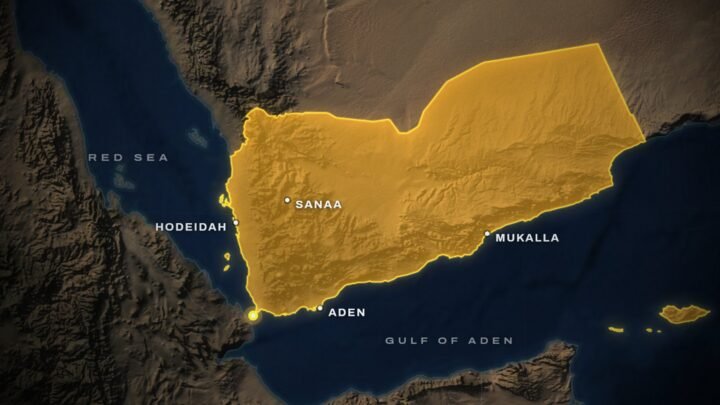
The bypass routes have their own weak points. Yanbu’s tankers must sail through the Red Sea, past Yemen’s coast. There, the Houthis declared a blockade of Saudi-linked shipping in July 2026 (see why nobody can conquer Yemen). And in September, drone attacks forced Saudi Arabia to shut the East-West pipeline for more than a week. Hormuz is one of several chokepoints that control world trade, and in 2026 two of them came under pressure at once.
Can Iran close the Strait of Hormuz legally?
Under the UN Convention on the Law of the Sea (UNCLOS), ships enjoy “transit passage” through straits used for international navigation. Unlike ordinary “innocent passage” through a country’s waters, transit passage cannot be suspended.
Iran signed the convention in 1982 but never ratified it. Its signing declaration says only states that join the treaty can claim transit passage. Iran also argues that it has consistently objected to the rule, so it does not bind Iran. The US has not ratified UNCLOS either. Before the war, according to the Atlantic Council, Iran still let US-flagged ships through.
Geography weakens Iran’s legal case. At the narrowest point, the agreed lanes lie in Oman’s waters, not Iran’s. In July 2026, Iran told Oman it no longer recognised the 1968 traffic scheme. Iran has also floated transit fees, which it says would be compulsory. Oman says any arrangement would involve no tolls.
The Atlantic Council calls the crisis a heavy blow to an already deteriorating maritime order. It also notes that the US, China and Russia have themselves violated or undermined the convention, which strengthens Iran’s argument. Disputes over sea rights run elsewhere too, as in the South China Sea dispute.
What to watch next in the Strait of Hormuz
As of 16 October 2026, four things will shape what happens next.
First, the talks. Iran’s seven-day plan, sent through Qatar, remains its stated offer. Trump rejected it, according to US officials quoted by The Wall Street Journal. Any deal would have to cover both the strait and the US blockade.
Second, the US calendar. An Iranian official linked the latest attacks partly to the US midterm elections on 3 November, according to Al Jazeera’s reporting. A US official has said another carrier, the USS Theodore Roosevelt, could give the US three carriers around Iran by the end of November.
Third, the mines. Iran says a ship sunk in October hit a mine, while Singapore says its ship was hit by a projectile. If mines spread, even a deal on paper may not bring shipowners and insurers back quickly.
Fourth, the routes. Watch the Iran-Oman talks on lanes and fees, and the new UAE pipeline due in 2027. More bypass capacity would reduce the strait’s leverage over time. The same contest over sea routes runs through the region’s other rivalries, from Yemen to Israel vs Turkey. For more analysis on the Middle East, see our region page.
Frequently asked questions
Can Iran close the Strait of Hormuz?
In practice, largely yes. Since the war began on 28 February 2026, Iran has declared the strait closed, attacked ships and allowed through only vessels it approves. It cannot seal it completely: some ships still pass, including under US-backed efforts. The cost is high for Iran too: under a US blockade, its seaborne crude exports fell to zero in September.
Is the Strait of Hormuz open or closed?
As of 16 October 2026, Iran says the strait remains closed and that any passage must be coordinated with its forces. Some ships still cross, but attacks surged in October, with at least 12 tankers hit in the week to 5 October. The US keeps a naval blockade on ships trading with Iran’s ports.
How much oil goes through the Strait of Hormuz?
In 2024, about 20 million barrels of oil a day passed through the strait, according to the US Energy Information Administration. That was about 20% of world oil consumption. About 84% of its crude went to Asia. The strait also carried about a fifth of global trade in liquefied natural gas.
Can Iran close the Strait of Hormuz legally?
It is disputed. Under the UN Convention on the Law of the Sea, ships have a right of “transit passage” through straits like Hormuz that cannot be suspended. Iran signed but never ratified the convention and argues that the right binds only member states. The main lanes also lie in Oman’s waters.
Can Iran close the strait without Oman?
Legally, Iran’s claim is weak, because at the narrowest point both shipping lanes lie in Oman’s waters. In practice, Iran has disrupted traffic with threats, attacks and its own routes past Larak Island. Oman has opened temporary routes and says it will not charge tolls.
Have ships been sunk in the Strait of Hormuz?
Yes. In May 2026, an Indian-crewed cargo vessel sank in crossfire between Iranian and US forces; one sailor died and 17 were rescued, Marine Insight reported. In mid-October, Reuters reported two more sinkings: the container ship GFS Pride, whose 21 crew were evacuated, and the bulk carrier Cape Dao, hit in September.
Sources
- Amid regional conflict, the Strait of Hormuz remains critical oil chokepoint
- About one-fifth of global liquefied natural gas trade flows through the Strait of Hormuz
- Part 1: Key Facts on Strait of Hormuz
- Straits of Hormuz traffic separation scheme keeps within Omani waters
- Iran publishes redrawn traffic scheme for Strait of Hormuz
- Iran proposes temporary Hormuz plan giving itself greater control over transit lines
- Oman opens temporary Strait of Hormuz shipping routes, says no tolls will be charged
- Iran, Oman advance plans for Strait of Hormuz transit fees despite US opposition
Show all 61 sources
- Five things to know about Iranian minelaying
- CENTCOM says US destroyed 16 Iranian mine-laying vessels
- Iran Update, August 31, 2026
- The Tanker War
- Lloyd's List tanker war supplement (report)
- Operation Praying Mantis
- US says Iran removed unexploded mine from oil tanker
- Iran seizes UK-flagged Stena Impero tanker in the Strait of Hormuz
- U.S. Conflict with Iran
- 2026 Iran war
- IEA member countries agree to release 400 mbl of oil stocks
- Saudi Arabia's East-West pipeline at full 7 million barrel capacity
- UAE speeds construction of new oil pipelines bypassing Strait of Hormuz
- New pipelines bypassing the Strait of Hormuz could come online in 1-2 years
- US to begin naval blockade of Iranian ports in the Strait of Hormuz
- Brent oil price rises to highest level since early in the war
- Trump launches Project Freedom to escort stranded ships out of Strait of Hormuz
- U.S. ends naval blockade of Iran
- Iran waives Hormuz transit fees for 60 days as US ends naval blockade under new MoU framework
- Hormuz sees traffic bump despite ongoing Iranian attacks
- Three tankers hit in latest attacks in the Strait of Hormuz, British military says
- CENTCOM: US naval blockade on Iranian ports to resume
- What's in Iran's seven-day plan to reopen the Strait of Hormuz?
- Iran stands firm on Hormuz plan after US rejection
- Iran says Hormuz to remain closed until US meets conditions
- Strait of Hormuz attacks surge as Iran steps up campaign against US-backed oil shipping
- Iran steps up Hormuz surveillance: attacks soar, oil flows crash again
- Iran hits tanker in Sohar and two in Hormuz; US disables bulker
- Iran says a ship sank after hitting a mine on Strait of Hormuz
- Iran: Strait of Hormuz remains closed, requires coordination for passage
- The crisis in the Strait of Hormuz is a heavy blow to the deteriorating maritime order
- Strait of Hormuz: why the US and Iran are sailing in very different legal waters
- Indian sailor dies after cargo ship sinks in US-Iran naval crossfire in Strait of Hormuz
- IRGC: Strait of Hormuz closed, vessels attempting to cross will be attacked (Anadolu)
- Strait of Hormuz 'closed' to hostile shipping: IRGC
- Bing, Bing, Gone: Is Trump underestimating Iran's fast attack craft?
- More tankers hit in Hormuz as U.S. strikes cargo ship
- US says it's hunting for explosive mines in latest push to open the Strait of Hormuz
- Iran insists it controls Hormuz as rial hits record low and exports dry up
- Saudi Arabian oil pipeline hit by projectiles, triggering fires
- Iran leader Khamenei killed in massive US and Israeli attack
- US-Iran ceasefire deal: what are the terms, and what's next?
- U.S. Forces to Resume Naval Blockade Against Iran
- Memorandum of Understanding between the Islamic Republic of Iran and the United States
- US-Iran deal promised 60 days of calm. Instead it provoked more conflict
- Iran likely laying Hormuz mines despite US scepticism
- Iran proposes reopening Hormuz Strait in 7 days; Trump rejects plan, WSJ reports
- Attacks on tankers in Hormuz hit highest of any week since start of Iran war, sources say
- Container ship sank after hitting naval mine in Hormuz: Iran Guards
- Two ships sink near Hormuz after being hit by projectiles amid surge in attacks
- Saudi resumes Yanbu oil loading after pipeline restart
- Strait of Hormuz
- U.S. deploys third aircraft carrier to Middle East as war with Iran enters eighth month
Facts as of 16 October 2026. Spotted a mistake? Tell us, and we will correct it.