Europe Analysis Episode 34
Why Russia Keeps Its Nukes Next to Norway
US intelligence says Russia keeps about two-thirds of its nuclear second strike on the Kola Peninsula, a short drive from Norway. Geography ties that insurance to a NATO neighbour, and both sides are now lifting the restraints that kept the border quiet.
In short
- US intelligence said in March 2026 that the Kola Peninsula hosts about two-thirds of Russia's second-strike nuclear capabilities, the weapons Russia would use to hit back after a nuclear attack.
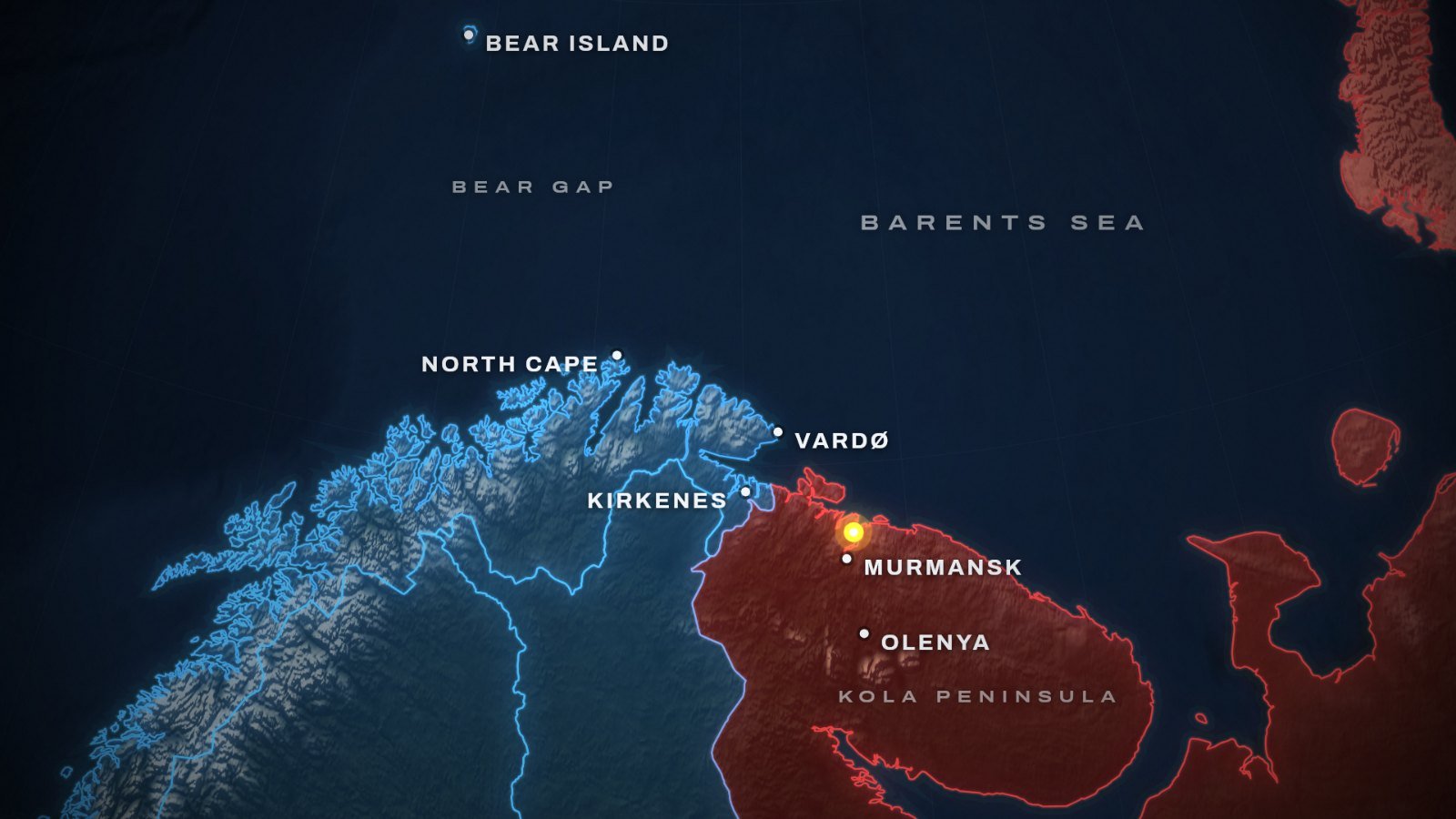
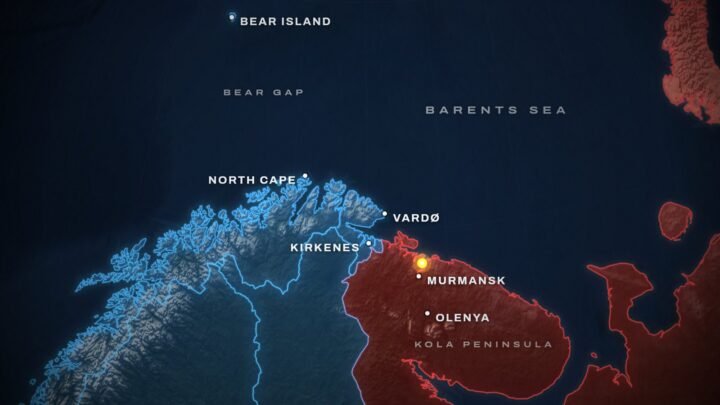
- Murmansk, at the heart of the fortress, lies about 145 km from the Norwegian town of Kirkenes and almost 1,500 km from Moscow.
- The main route from Kola's submarine bases to the Atlantic runs past Norway's coast, first through the Bear Gap between the North Cape and Bear Island.
- Norway is easing the limits it set itself near Russia from 1949 onwards: in August 2026, British surveillance planes flew from Norwegian bases over the Barents Sea north of Kola.
- Norway's chief of defence said in February 2026 that Russia shows no Ukraine-style ambitions toward Norway, but that he cannot rule out a land grab to protect Russia's nuclear forces in a wider war.
In this analysis 8 sections
- 01Why is the Kola Peninsula so important to Russia?
- 02How did Russia's fortress end up next to Norway?
- 03What is Russia's nuclear bastion in the Barents Sea?
- 04Why does Norway stand in the way?
- 05Where is the Kola fortress weak?
- 06How are Norway and Russia answering each other?
- 07What to watch next
- 08Frequently asked questions
In mid-October 2026, Russia closed wide stretches of the Barents and White Seas to ships and aircraft, yet announced no major exercise, reported the Barents Observer, a Norwegian outlet that tracks flights. On 14 October, it added, at least four NATO surveillance planes worked the skies west, south and north of the Kola Peninsula.
All of this circles one small corner of the map. Russia keeps its most precious weapons here, around the city of Murmansk. That is about 145 kilometres from the Norwegian town of Kirkenes, and almost 1,500 kilometres from Moscow. So why does Russia keep them right next to NATO? And how far would it go to protect them?
Why is the Kola Peninsula so important to Russia?
Start with the sea. Much of Russia’s Arctic coast freezes for months. But a branch of the warm North Atlantic Current, the Gulf Stream’s extension, keeps Kola’s northern coast free of ice.
During the First World War, Russia needed a supply port that never froze. So in 1916 it founded Romanov-on-Murman on the Kola Bay, renamed Murmansk in 1917.
Today the Kola Peninsula is home to Russia’s Northern Fleet, run from Severomorsk since 1947. In March 2026, the US intelligence community’s Annual Threat Assessment put the stakes in one sentence:
“The bulk of Russia’s Arctic forces are concentrated in the Kola Peninsula, which hosts about two-thirds of Russia’s second-strike nuclear capabilities.”
US Office of the Director of National Intelligence, March 2026
Yet this fortress sits at the far edge of the country. By land, one railway line and one main road link it to the rest of Russia.
| Kola and its neighbours | Figure | As of / basis |
|---|---|---|
| Kola’s share of Russia’s second-strike nuclear capability | about two-thirds | US intelligence, March 2026 |
| Ballistic-missile submarines with the Northern Fleet | 7 (US count; IISS: 6) | 2026 |
| Bulava missiles per Borei-class submarine | 16 | 2025 |
| Norway–Russia border | about 198 km, one crossing | since 2018 |
| Murmansk to Kirkenes | about 145 km | straight line |
| Vardø radars to Gadzhiyevo | about 150 km | straight line |
| Bear Gap: North Cape to Bear Island | about 420 km | straight line |
| New barracks at Pechenga to Norway | about 10 km | June 2026 |
How did Russia’s fortress end up next to Norway?
History drew this border. Russia and Norway first agreed a frontier in 1826. Then, in 1920, Finland gained Petsamo, a corridor to the Arctic Ocean, and Russia lost its border with Norway.
That changed in 1944. Under the Moscow armistice of 19 September 1944, Finland gave Petsamo back, and a 1947 peace treaty confirmed it. Today the area is called Pechenga. The Red Army had freed Kirkenes from German occupation in October 1944, and it left Norway in September 1945.
Today the border runs for about 198 kilometres, from the Barents Sea to the tripoint with Finland. Storskog is the only crossing.
In 1949, Norway became a founding member of NATO. But on 1 February 1949, in a note to Moscow, it promised no bases for foreign forces, as long as no one attacked or threatened Norway. In 1957, it added a second pledge: no nuclear weapons on its soil in peacetime. From the 1950s, it also limited allied flights and naval visits near the border, and kept allied ground troops out of Finnmark.
None of this was ever a treaty with Moscow. Norway even refused the non-aggression pact the Soviet Union offered in 1949. These were Norway’s own choices, made to keep the far north calm. For about 75 years, they did. Oslo loosened the Finnmark limits in 1995, and again in May 2025, to allow more allied training with Sweden and Finland.
What is Russia’s nuclear bastion in the Barents Sea?
The bastion grew out of a new missile. From 1973, Soviet Delta-class submarines carried the R-29, with a range of about 7,700 kilometres. They could now reach the United States from home waters in the Barents and Norwegian Seas.
So the Soviet navy, then led by Admiral Sergei Gorshkov, kept them close. A ring of surface ships, aircraft and attack submarines guarded them. Western analysts called this protected sea a bastion. Soviet writing rarely used the word.
Today, the core of the fortress is the Borei class. Each of these submarines carries 16 Bulava missiles, and the fifth improved Borei-A joined the fleet in July 2025. Kola’s boats sail from Gadzhiyevo, north of Murmansk, home of the Northern Fleet’s 31st Submarine Division. The fleet’s Yasen-class attack submarines berth next to Zaozersk, about 60 to 70 kilometres from the Norwegian border.
In March 2026, US intelligence counted seven nuclear-armed ballistic-missile submarines with the Northern Fleet. The International Institute for Strategic Studies counts six of Russia’s 12.
Why a second strike matters
These boats carry much of Russia’s second strike: the power to hit back with nuclear weapons even after an enemy’s surprise attack. An enemy can map silos on land. A submarine deep under the sea is far harder to find.
Russia does not rely on submarines alone. Most of its strategic warheads sit on land-based missiles, including road-mobile Yars launchers, according to a 2026 report for the US Congress. Only part of the submarine force is at sea at any time, and boats in port at Gadzhiyevo are exposed. Even so, for Moscow, Kola holds the Russian state’s insurance policy.
Why does Norway stand in the way?
The main route from Kola to the Atlantic runs past Norway’s coast. First comes the Bear Gap, the open sea between Norway’s North Cape and Bear Island, about 420 kilometres wide. Some definitions stretch the gap north to Svalbard.
Further south lies a second gate, the GIUK gap between Greenland, Iceland and Britain. That is one reason Washington cares so much about Greenland.
So Norway’s long coast gives NATO a front-row seat. Norway’s five P-8A Poseidon patrol planes fly from Evenes in northern Norway to hunt submarines. At Vardø, close to the border, the GLOBUS radars stand about 150 kilometres from Gadzhiyevo. Norway’s intelligence service runs them with the United States.
Moscow says the radars watch Russian territory, track the Northern Fleet and feed American missile defence. Norway says they serve its own intelligence and space surveillance, not US missile defence. For Washington and London, tracking these submarines is at the heart of keeping the Atlantic safe.
At the top of the gap lies Svalbard. A treaty signed in 1920 recognises Norway’s sovereignty over the islands, but its Article 9 bans naval bases and fortifications there. Russia runs the coal-mining town of Barentsburg. Moscow accuses Norway of militarising the islands and of restricting Russia’s lawful presence. Norway says it acts within the treaty.
Where is the Kola fortress weak?
Yet the fortress has a weakness, and the map itself creates it. Everything Russia guards most closely sits in one narrow, crowded corner next to NATO.
That corner has grown tighter. Finland joined NATO on 4 April 2023, adding a 1,340-kilometre frontier with Russia. Sweden followed on 7 March 2024, after 200 years of neutrality. The alliance now sits on both of Kola’s foreign land borders.
Moscow reorganised in response. Since 1 March 2024, the Murmansk region has belonged to a re-created Leningrad Military District, a change Putin tied to Finland joining NATO.
The war in Ukraine thinned the guard
For years, the 200th Motor Rifle Brigade at Pechenga guarded Kola by land. It went to fight in Ukraine and suffered heavy losses. By January 2026, Russia had reorganised it into a new, larger division, at least on paper. Arctic reporters then saw no sign of a real rebuild.
The war reached Kola itself, too. On 1 June 2025, Ukrainian drones launched from trucks inside Russia hit Olenya air base, about 90 kilometres south of Murmansk. Satellite images showed at least four Tu-95MS bombers and an An-12 transport plane destroyed.
Russia’s answer is to build for later. In June 2026, a joint satellite investigation by NRK, SVT, DR and Delfi found new barracks at Pechenga, about 10 kilometres from Norway. Marko Eklund, a former Finnish intelligence officer, estimates the room there could grow from about 7,000 troops to 17,000. That is room, not soldiers: experts expect the troops only after the active phase of the war in Ukraine. Russia’s foreign ministry calls the build-up “defensive in nature”.
Could Russia seize Norwegian land to protect Kola?
In February 2026, Norway’s chief of defence, General Eirik Kristoffersen, told The Guardian that Norway cannot rule out a Russian land grab, as part of a plan to protect Russia’s nuclear forces. However, he said Russia shows no Ukraine-style territorial ambitions toward Norway. His worry is narrower: a limited move in a wider war, to shield the submarines. A fortress that feels exposed may be more dangerous, not less.
There is a precedent, of sorts. In 2014, Russia annexed Crimea, which Ukraine and most UN members regard as Ukrainian; Moscow calls it a reunification. Many analysts see the Black Sea Fleet’s base at Sevastopol as one of the key reasons. But Ukraine was not in NATO, and Russia’s fleet was already inside Crimea. Norway has been in NATO since 1949. It is a strategic analogy, not a blueprint.
How are Norway and Russia answering each other?
Norway is answering by building up, and by lifting its own limits. On 20 August 2025, it set up the Finnmark Brigade on the Russian border. A year later, the brigade gained an artillery battalion with South Korean K9 guns, an air-defence battery and a signals company. Only four K9s had arrived by then, with 24 more due in 2028.
In March 2026, about 32,500 troops from 14 allied nations trained in Norway and Finland, in the exercise Cold Response. Several thousand were American. Britain also plans to double its troops in Norway, from about 1,000 to 2,000, over three years.
The sharpest change came in the air. In August 2026, a British RC-135 spy plane took off from Ørland, and a British P-8 from Evenes, to fly over the Barents Sea north of Kola. Norway had eased its Cold War limits on allied surveillance flights toward Russia’s nuclear fleet. Oslo says it coordinates such missions. “We remain a predictable and responsible neighbour, committed to preserving stability and low tension in the High North,” said Defence Minister Tore O. Sandvik, quoted by the Barents Observer.
On 2 September 2026, the Governor of Svalbard seized a Russian ship, the Professor Molchanov, at Barentsburg. A Norwegian court had ordered it on 31 August. The order enforces a $4.22 billion arbitration award that Ukraine’s energy company, Naftogaz, won in 2023 over assets it lost in Crimea. Russia’s embassy said it would appeal; Norway’s justice ministry calls it a legal dispute between Naftogaz and Russia.
How Moscow sees it
In Murmansk in March 2025, Vladimir Putin said: “Russia has never threatened anyone in the Arctic.” But he added that Russia would follow developments closely, and answer by increasing its military capability and modernising its military infrastructure.
After the ship seizure, Moscow summoned Norway’s ambassador, and its foreign ministry spoke of piracy. On 3 September 2026, Putin called seizures of civilian ships “state terrorism”.
Seen from Moscow, NATO is now on its doorstep, with spy planes flying from Norwegian bases toward the submarines that guard Russia’s security. Oslo calls each step defensive, an answer to Russia’s war and its build-up next door. So each side’s defence now looks like a threat to the other.
What to watch next
First, the Barents Sea this autumn. The mid-October closures came with no announced major exercise, the Barents Observer reported. Kristian Åtland, a researcher at the Norwegian Defence Research Establishment, said the overlapping periods may point to a larger autumn exercise. Meanwhile, satellite images of 8 October, from an open-source analyst, showed about 40 bombers at Olenya, in one day’s picture.
Second, the Finnmark Brigade. In an interview published on 20 October, Norway’s acting army chief, Brigadier Trond Nilsen, said 16 South Korean Chunmoo rocket launchers start arriving in 2028. The brigade should be complete by about 2033, two years earlier than planned.
Last, the risk of an accident. With more planes, ships and submarines working close together, one intercept could go wrong. That is why General Kristoffersen wants a military hotline with Moscow. Some practical ties remain, such as search and rescue, and the two still agreed fishing quotas for 2026.
For 75 years, restraint kept this border quiet. Now both sides are letting it go. Russia’s build-up next to Norway is not mainly about Norway. It is about what hides under the Barents Sea, and how far Moscow would go to keep it hidden. For more analysis on Europe, see our regional page.
Frequently asked questions
What is the Kola Peninsula?
The Kola Peninsula lies in Russia’s far north-west, between the Barents Sea and the White Sea, in the Murmansk region. A warm Atlantic current keeps its northern coast free of ice. So it became home to Russia’s Northern Fleet, around Murmansk, and to many of its nuclear missile submarines.
Why is the Kola Peninsula important to Russia?
US intelligence says the Kola Peninsula hosts about two-thirds of Russia’s second-strike nuclear capabilities: the weapons Russia would use to hit back after a nuclear attack. Its ice-free coast gives the Northern Fleet access to the Atlantic, and its missile submarines patrol the nearby Barents Sea under heavy guard.
How long is the Norway Russia border?
The Norway–Russia border is about 198 kilometres long; Norway’s police give 197.7 kilometres after a re-measurement agreed in 2018. It runs from the Barents Sea coast east of Kirkenes to the tripoint where Norway, Russia and Finland meet. Storskog is the only crossing.
What is the Russian Northern Fleet?
The Northern Fleet is Russia’s navy in the Arctic, run from Severomorsk, near Murmansk, since 1947. It holds many of Russia’s nuclear-armed ballistic-missile submarines: seven by the US intelligence count of March 2026, six of 12 by the IISS count. Since March 2024, its home region has belonged to the re-created Leningrad Military District.
Could Russia invade Norway?
Norway’s chief of defence, General Eirik Kristoffersen, said in February 2026 that Russia shows no Ukraine-style territorial ambitions toward Norway. But he cannot rule out a limited Russian land grab in a wider war, to protect Russia’s nuclear forces on Kola. Vladimir Putin said in March 2025 that Russia has never threatened anyone in the Arctic.
Watch the video
Why Russia Keeps Its Nukes Next to Norway
The video loads from YouTube in privacy-enhanced mode, only when you press play.
Sources
- Annual Threat Assessment of the U.S. Intelligence Community
- Ukraine war undermining Russia's Arctic plans, US intelligence says
- NATO maintains intensive surveillance amid Russian Arctic training and weapons testing
- Norway to receive Chunmoos in 2028, reach IOC in 2029: Norwegian Army leader
- Satellite images of Olenya Air Base as of 8 October
- Kola Peninsula
- Murmansk
- Hero City Murmansk founded
Show all 68 sources
- Treaty of Peace with Finland, Paris, 1947
- 70 years since last Soviet troops left Norway
- The Norwegian-Russian border
- Russia just got a 'longer' border to Norway
- Norway and NATO
- Foreign Relations of the United States, 1951, Volume IV, Document 345
- Baseerklæringen
- Dokument 12 (2019–2020), constitutional proposal
- Norway's self-imposed restrictions in Finnmark
- Norway is adjusting its guidelines in Finnmark to enable more training with Sweden and Finland
- R-29 / SS-N-8 Sawfly
- No bastions for the Bear, round 2
- With Putin's blessing, Russia commissions fifth Borei-A SSBN
- Russian navy to restructure Project 955/955A Borey SSBN deployment
- Project 885M SSGN Kazan arrives at Zaozyorsk base
- Factbox: military assets in the Arctic
- Report to Congress on Russia's nuclear weapons
- Northern Fleet missile warnings north and south of Bear Island
- Norway receives final Poseidon MMA
- US and Norway upgrade eye on northern Russia
- GLOBUS – radar
- Norway says Vardø radar is not part of US missile defence
- The Svalbard Treaty
- Russia accuses Norway of militarizing Svalbard Arctic islands
- Finland becomes 31st member of NATO
- Sweden joins NATO as 32nd Alliance member
- Russia's Northern Fleet loses status of strategic multi-service formation — decree
- Russia's only railway bridge to Murmansk collapses
- Battered infantrymen of Pechenga become part of new motorised division
- Satellite images from Olenya show 4 strategic bombers destroyed
- Joint investigation maps Russia's military buildup along its NATO border
- Northern Europe faces largest Russian military buildup in decades, investigation reveals
- Norway's defence chief on the risk from Russia
- Norway's defense chief does not rule out risk of Russian invasion
- Norway's defence chief favours a military hotline with Moscow
- Norway boosts defence footprint with expansion of Arctic brigade
- Norway strengthens the Arctic Finnmark Brigade with three new units
- Norway forms K9 Vidar artillery battalion in Arctic north
- Oslo ratchets up defence plan, strengthens control in border region
- Cold Response 2026
- 4,000 US soldiers deploy to Norway for Arctic exercise
- CORE26 | Marines forge new role for collective Arctic defense in NATO exercise
- UK to deploy more troops to Norway in response to Putin's Arctic threat
- Norway softens self-imposed restrictions on allied surveillance aircraft monitoring Russia's nuclear fleet
- Allied surveillance flights from Norway
- Nå har allierte spionfly tatt av fra Norge og flydd til Russland
- Russian ship seized in Svalbard
- Norway seizes Russian vessel in remote Arctic, drawing Putin's ire
- Putin on the seizure of civilian vessels
- Norway's ambassador summoned to Moscow foreign ministry as wave of propaganda hits the headlines
- Norway repatriates 69 Russians from ship seized in Arctic
- Russia's embassy says it will appeal the seizure of the Professor Molchanov
- Norwegian-Russian fisheries agreement for 2026: 'Noteworthy,' says researcher
- On ice but not broken: Norwegian–Russian relations in polar science since 24 February 2022
- Putin lauds Arctic cooperation while boosting regional militarization
- Putin sends a clear warning as Trump tries to take over Greenland
- Putin says Russia will increase number of military personnel in the Arctic
- Territorial integrity of Ukraine: resolution adopted by the General Assembly
- Why Putin took Crimea
- The naval base at the heart of Putin's fight for Crimea
Facts as of 20 October 2026. Spotted a mistake? Tell us, and we will correct it.