Asia-Pacific Analysis Episode 42
The Strait of Malacca: China’s Biggest Weakness
In 2025, about three-quarters of China's seaborne crude passed one narrow strait shared by three other countries. Beijing has spent two decades building ways around it. The 2026 oil shock showed how far it has got, and why the strait is no simple off switch.

In short
- In the first half of 2025, about 23.2 million barrels of oil a day passed through the Strait of Malacca, more than through any other chokepoint, according to the US Energy Information Administration.
- About three-quarters of China's seaborne crude imports passed through the strait in 2025, according to the tanker tracker Vortexa, cited by Reuters.
- Even at full capacity, every oil pipeline into China could carry only about an eighth of the crude China imported in 2025.
- RAND Europe estimated China's oil stockpile at 1.1 to 1.4 billion barrels in May 2026, about four months of imports on paper; Beijing publishes no figures.
- Indonesia, Malaysia and Singapore pledged in August 2026 to keep the strait open, and under the law of the sea the bordering states may not suspend ships' right of transit passage.
In this analysis 8 sections
- 01Where is the Strait of Malacca, and why does it matter?
- 02What is the Malacca dilemma?
- 03How has China tried to get around the Strait of Malacca?
- 04Oil tanks and warships: can China protect its supply?
- 05How did the Hormuz crisis test China's Malacca dilemma?
- 06Could the United States block the Strait of Malacca?
- 07What to watch next
- 08Frequently asked questions
On 14 October 2026, China’s customs data showed that crude imports fell 21.5% in September from a year earlier. It followed months of double-digit falls. Behind them is the war with Iran, which has choked the Strait of Hormuz since late February. So Beijing has drawn on its stockpile and turned to other sellers, such as Brazil.
Yet their tankers use the same narrow door as Gulf oil: the Strait of Malacca, or the Indonesian straits beside it. Why does a strait lined by other countries remain China’s biggest weakness? And could the United States really shut it?
Where is the Strait of Malacca, and why does it matter?
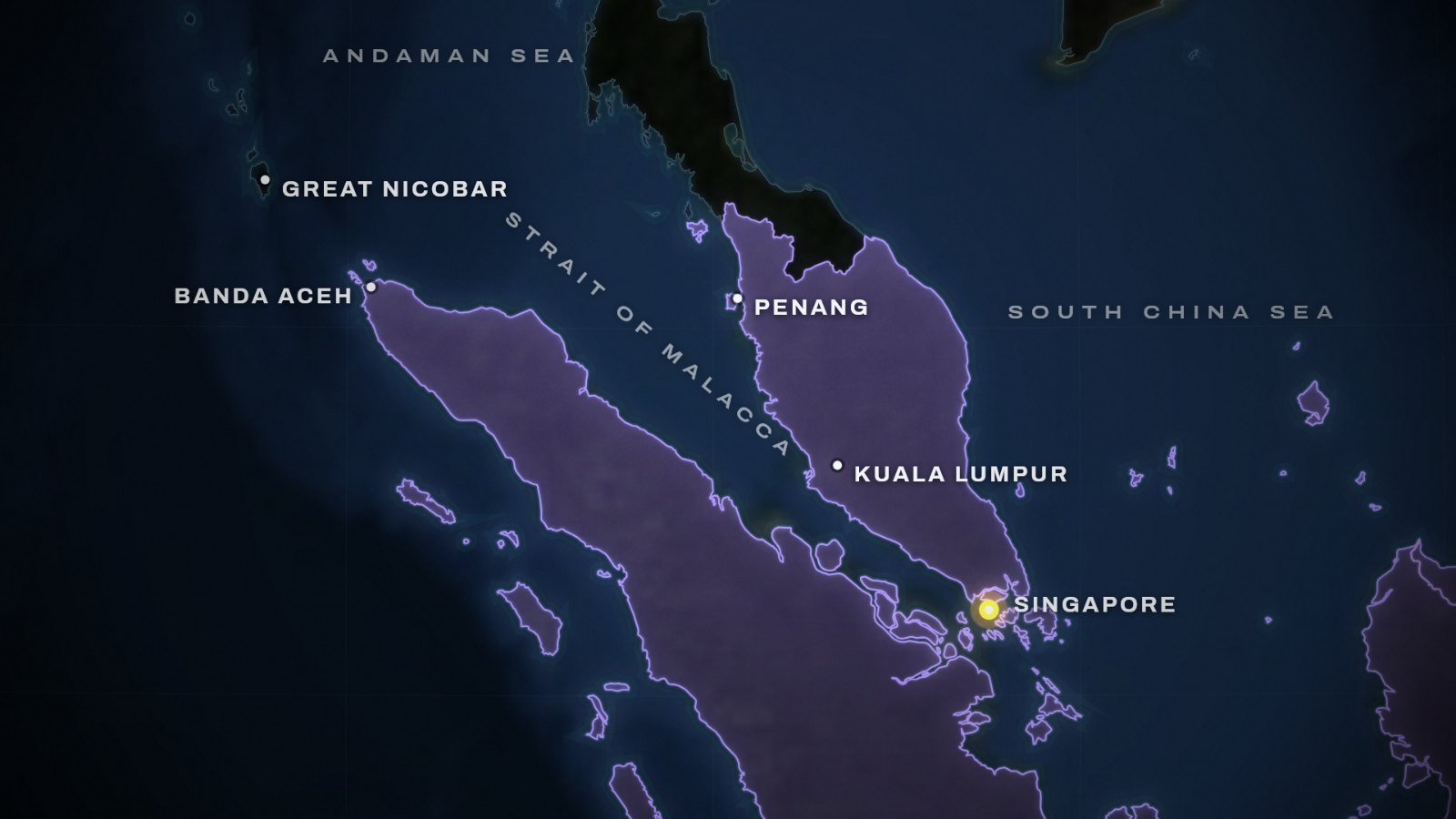
The Strait of Malacca runs between the Malay Peninsula and the Indonesian island of Sumatra. It is about 900 km long, though estimates range from 800 to 930 km. It links the Indian Ocean to the Pacific, and it is the shortest sea route from the Gulf’s oil suppliers to East Asia, according to the US Energy Information Administration (EIA).
The strait is shaped like a funnel. It is about 250 km wide in the north and only about 65 km at its southern end, according to Britannica. Off Singapore, the shipping lane narrows to about 2.7 km in the Phillips Channel. That is roughly the length of San Francisco’s Golden Gate Bridge. Its shallowest stretches are only about 25 metres deep. So the biggest supertankers, sitting over 20 metres deep when fully loaded, sail round through Indonesia’s Lombok and Makassar straits.
Who owns the strait?
Portugal seized the port of Malacca in 1511, and Britain set up a trading post at Singapore in 1819. In 1824, a treaty split the region: Britain took the Malay side, and the Dutch took Sumatra. That line still shapes the border between Malaysia and Indonesia.
Today the shores belong to Malaysia, Indonesia and Singapore, and no country charges ships a toll. Under the UN Convention on the Law of the Sea, Malacca is a strait used for international navigation. So every ship has a right of “transit passage”. Article 44 of the convention says there “shall be no suspension of transit passage”.
How much oil passes through the strait?
More than 102,500 ships passed through in 2025, according to Malaysia’s Marine Department. That is about one every five minutes. In the first half of 2025, before the war, about 23.2 million barrels of oil a day went through. That was 29% of all oil moved by sea, according to the EIA’s chokepoint data. No other chokepoint carried more, so Malacca leads the chokepoints that control world trade by oil volume. It was also more oil than the whole United States used each day in 2025.
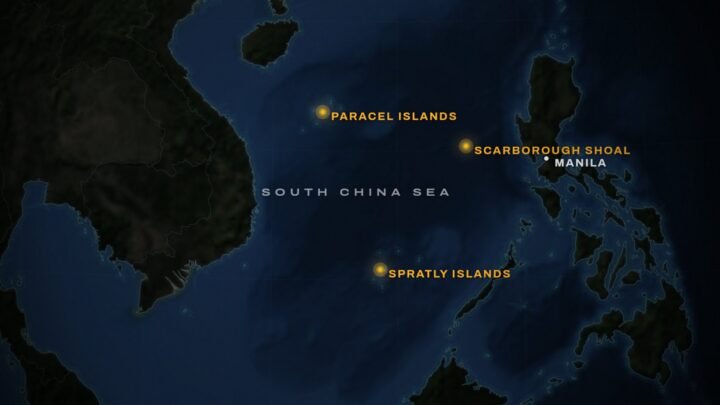
Ships leaving it to the north-east enter the disputed South China Sea. China claims most of those waters, and its neighbours contest those claims.
| Key numbers | Figure | Source and date |
|---|---|---|
| Length | About 900 km (estimates range from 800 to 930 km) | Reuters; Britannica |
| Width | About 250 km in the north, 65 km in the south | Britannica |
| Narrowest shipping lane | About 2.7 km, Phillips Channel off Singapore | EIA |
| Shallowest stretches | About 25 metres deep | The Star, 2026 |
| Ships through the strait | More than 102,500 in 2025 (94,300 in 2024) | Malaysia’s Marine Department, via Reuters |
| Oil through the strait | About 23.2 million barrels a day, 29% of oil moved by sea | EIA, first half of 2025 |
| China’s crude imports | A record 11.6 million barrels a day; 8.1 million in the second quarter of 2026 | China’s customs, 2025; EIA |
| China’s seaborne crude via Malacca | About three-quarters | Vortexa, via Reuters, 2025 |
| China’s oil stockpile | An estimated 1.1 to 1.4 billion barrels | RAND Europe, estimate for May 2026 |
| US Strategic Petroleum Reserve | About 283 million barrels | US Energy Department, via Reuters, early October 2026 |
What is the Malacca dilemma?
In 2025, China imported a record 11.6 million barrels of crude a day. Its own fields pumped about 4.3 million, so more than 70% of its crude came from abroad. About three-quarters of its seaborne crude passed through Malacca, according to the tanker tracker Vortexa, cited by Reuters. The often-quoted 80% figure dates from the 2000s.
In late 2003, China’s then leader, Hu Jintao, reportedly warned that certain powers were trying to control the strait. He named no country, but analysts read it as a warning about the United States. His worry became known as the “Malacca dilemma”. It is the fear that a rival could cut China’s energy lifeline at a passage it does not control.
Who watches the lane?
US forces have had access to Singapore’s air and naval bases since 1990, under a deal extended to 2035. In April 2026, Washington and Jakarta also set up a major defence partnership, though not an alliance.
At the western mouth sit India’s Andaman and Nicobar Islands. Since 2001, they have hosted India’s only tri-service theatre command. In June 2026, India approved a civil and military airport on Great Nicobar. Critics contest the wider port-and-city plan on environmental and tribal-rights grounds. The island’s southern tip lies about 200 km from mainland Sumatra.
How does each side see the strait?
The US Navy has described its passages through the strait as a sign of its commitment to free and open sea lanes. In August 2026, two US aircraft carriers used the strait as a highway, to and from the war with Iran. New Delhi sees the Indian Ocean as its home waters, and its government has not threatened to close the strait.
Beijing frames its pipelines and stockpiles as energy security. Xi Jinping has put energy self-reliance into China’s new five-year plan, AP reported. However, some Chinese analysts warn that India’s island build-up threatens China’s lifeline through Malacca. One prominent scholar, Jin Canrong of Renmin University, wrote in May that it makes the dilemma more serious.
Indonesia, Malaysia and Singapore see the strait as theirs to keep open. On 25 August 2026, they affirmed its status as a strait used for international navigation. They also pledged to keep it open and safe. Indonesia also keeps its options open: it joined BRICS, the bloc that includes China, in January 2025, then signed its US partnership in April 2026.
What is a distant blockade?
Western strategists describe the danger as a distant blockade. A navy would stop China-bound tankers far out in the Indian Ocean, away from the neutral narrows. Yet one American analyst, Sean Mirski, concluded in 2013 that a blockade of China could work only in a long war. It would also need key regional powers on America’s side.
How has China tried to get around the Strait of Malacca?
Since 2003, Beijing has built ways around the strait, one by one. None of them replaces it.
Can pipelines replace the strait?
The most direct route is the oil pipeline from Kyaukphyu, on Myanmar’s coast, to Kunming in south-west China. It opened in 2017 and was built for about 440,000 barrels a day. Yet it ran at less than half that in 2020, according to Argus. Even full, it would carry less than 2% of Malacca’s pre-war oil traffic. It is fed by Gulf tankers, and it crosses a country at civil war, where pipeline sites have come under attack.
Farther north, oil comes by pipe from Russia, and through Kazakhstan on a line that mostly carries Russian oil. Russian gas arrives through the Power of Siberia line, but a second, larger line, Power of Siberia 2, still has no contract.
What about ports and canals?
In Pakistan, a Chinese company runs the port of Gwadar. But no oil pipeline links it to China. In Thailand, a canal across the Kra Isthmus was never approved. In August 2026, Thailand also shelved a land bridge worth about $30 billion, after a finance-ministry review found it uneconomic. Prime Minister Anutin says it is frozen, not abandoned.
| Route around Malacca | Oil capacity | The catch |
|---|---|---|
| Myanmar pipeline, Kyaukphyu to Kunming (2017) | About 440,000 barrels a day | Less than half used in 2020; fed by tankers; crosses a country at civil war |
| Spur from Russia’s ESPO pipeline | About 600,000 to 700,000 barrels a day | Russian oil only |
| Kazakhstan-China pipeline | About 400,000 barrels a day | Mostly carries Russian oil |
| Gwadar, Pakistan | No pipeline | A Chinese-run port, about 2,000 km from Kashgar in a straight line |
| Thailand’s Kra canal and land bridge | Nothing built | Canal never approved; land bridge shelved in August 2026 |
| All oil pipelines together | About 1.4 to 1.5 million barrels a day | About an eighth of China’s 2025 imports |
Running flat out, every oil pipeline into China could carry about an eighth of China’s 2025 imports. The rest still comes by sea.
Oil tanks and warships: can China protect its supply?
If the oil must come by sea, Beijing’s answer comes in two parts: oil tanks and warships.
How big is China’s oil stockpile?
By the EIA’s estimate, China held the world’s largest oil stockpile at the end of 2025. Beijing publishes no figures, so every number is an estimate. RAND Europe estimated China’s crude stocks at 1.1 to 1.4 billion barrels as of May 2026. That was about 110 to 140 days of net imports, and roughly four to five times what was left in America’s Strategic Petroleum Reserve in early October.
Others are more cautious. In May, Gabriel Collins of the Baker Institute wrote that the stocks “nominally cover 120 days of imports”. In practice, he estimated, they give “closer to 60–90 days of working time” before refiners cut back. So the tanks buy time, not freedom.
Can China’s navy guard the route?
The Pentagon’s 2024 report counted more than 370 Chinese ships and submarines. That made China’s navy the world’s largest by number of ships. Along the route, China opened a base in Djibouti in 2017, which Beijing calls a logistics facility. Chinese companies also run the commercial ports of Gwadar and of Hambantota, in Sri Lanka. Sri Lanka says its own navy handles Hambantota’s security.
In Cambodia, China paid to expand the naval base at Ream, about 1,000 km from Singapore. In 2022, The Washington Post reported that a new facility there was for the exclusive use of China’s navy. Both governments denied it, and Phnom Penh says warships from all friendly countries may visit. In January 2026, USS Cincinnati became the first US warship to dock there since the expansion.
Yet none of these sites sits on Malacca. China’s island of Hainan lies about 2,000 km from Singapore. So a fleet guarding the strait would have its own long lifeline to protect.
How did the Hormuz crisis test China’s Malacca dilemma?
In 2026, the dilemma got a real test. On 28 February, the United States and Israel attacked Iran, and Iran choked the Strait of Hormuz. On 13 April, the US blockaded Iran’s ports. Within days, it was turning back ships, including Chinese-linked tankers. China’s foreign ministry called it “dangerous and irresponsible behaviour”.
China absorbed the shock. In the second quarter, it imported 32% less crude than in the first, the EIA found. It also drew on its stocks and changed suppliers. By sea, Brazil was its biggest single supplier from January to August, according to the shipbroker Banchero Costa. Meanwhile, the Middle East’s share of those cargoes fell to about a third.
Yet tankers from Brazil and West Africa still pass through Malacca or the Indonesian straits beside it. So the oil China bought instead came through the same door.
How did the strait states respond?
On 22 April, Indonesia’s finance minister floated a Malacca toll, modelled on Iran’s plans for Hormuz. Within two days, Jakarta had dropped the idea, and Malaysia warned against unilateral moves. Singapore was the bluntest:
“The right of transit passage is guaranteed for everyone.”
Vivian Balakrishnan, Singapore’s foreign minister, 22 April 2026
He added that Singapore would “not participate in any attempts to close or interdict or to impose tolls in our neighbourhood”. The three strait states, he said, work together to keep the straits open, not to collect tolls.
In early May, two Iranian supertankers took Indonesia’s Lombok Strait instead of Malacca. Jakarta said they had a legal right to pass.
Has China solved the dilemma?
The satellite tracker Kayrros put China’s crude stocks on 11 October at about 1.18 billion barrels, their lowest in 16 months. Still, ship-tracking data suggest imports may climb back in October, Reuters columnist Clyde Russell wrote on 20 October. On 6 October, a Semafor column argued that China has resolved its Malacca dilemma. It pointed to China’s stockpiles, pipelines and coal-to-chemicals industry. Others disagree. In May, an article in Foreign Policy argued that insurance, not warships, may be the sharper weapon. In a war over Taiwan, it suggested, the US could price China’s tankers out of Western insurance.
Could the United States block the Strait of Malacca?
So could America simply switch China off at Malacca? The 2026 test suggests not, for five reasons.
First, tankers can go around, through the Sunda, Lombok and Makassar straits.
Second, China can absorb a shock. In the second quarter of 2026 it imported about a third less crude than in the first, and drew on its tanks.
Third, the law and the neighbours. The three strait states have pledged to keep it open. A wartime blockade is a separate legal question, but stopping tankers by force would be an act of war.
Fourth, the dilemma cuts both ways. In 2025, Japan got about 94% of its crude from the Middle East. South Korea got about 70%, through the same waters.
Fifth, time. With roughly two to four months of oil in its tanks, on the estimates above, any blockade would take weeks, even months, to bite.
So Malacca is less a switch than a clock: a slow squeeze that would likely work only in a long war. In peacetime, it is a deterrent and a bargaining chip. Analysts picture such a squeeze in a crisis over Taiwan, which Beijing claims and which governs itself.
History shows the danger in any squeeze. On 1 August 1941, the United States cut off oil to Japan. Japan had bought roughly four-fifths of its imported oil from America. Britain and the Dutch followed. Tokyo chose war rather than back down: Pearl Harbor, and a dash for the oil of the Dutch East Indies. China is not Japan, though. It has land routes Japan lacked, and far more oil of its own: in 2025 its fields supplied more than a quarter of its crude, while Japan in the late 1930s produced less than a tenth of the oil it used.
What to watch next
As of 21 October 2026, four things will shape the Malacca dilemma.
First, the summit. Donald Trump says he is open to meeting Xi Jinping at the APEC summit in Shenzhen on 18-19 November.
Second, the gas deal. On 21 October, Russian deputy prime minister Alexander Novak said a deal on Power of Siberia 2 could come this year. Moscow has set such deadlines before.
Third, the tanks. China’s October import figures, due in early November, will help show whether it is refilling its stocks.
Fourth, the bases and bypasses. Watch Great Nicobar and Ream, and whether Thailand revives its land bridge. For more analysis on Asia and the Pacific, see our region page.
Frequently asked questions
What is the Malacca dilemma?
The Malacca dilemma is China’s fear that a rival could cut its oil supply at the Strait of Malacca. About three-quarters of China’s seaborne crude passed through the strait in 2025. The phrase traces back to late 2003, when China’s leader, Hu Jintao, reportedly warned that certain powers were trying to control it.
Why is the Strait of Malacca important?
It links the Indian Ocean to the Pacific, and it is the shortest sea route from the Gulf’s oil suppliers to East Asia. It is also the world’s largest oil chokepoint by volume. In the first half of 2025, about 23.2 million barrels of oil a day passed through, the EIA says. More than 102,500 ships made the crossing in 2025.
Which country does the Strait of Malacca belong to?
No single country owns it. Malaysia, Indonesia and Singapore share its waters. Under the UN Convention on the Law of the Sea, it is a strait used for international navigation. So ships of every country have a right of transit passage. The bordering states may not suspend that right.
How wide is the Strait of Malacca?
The strait is shaped like a funnel: about 250 km wide in the north and about 65 km at its southern end, according to Britannica. But its main shipping lane narrows to about 2.7 km in the Phillips Channel, off Singapore. Its shallowest stretches are only about 25 metres deep. So the largest fully laden supertankers use other routes.
Is there a toll on the Strait of Malacca?
No country charges ships a toll to pass. In April 2026, Indonesia’s finance minister floated a toll modelled on Iran’s plans for Hormuz. Jakarta dropped the idea within days. Singapore said it would not take part in any attempt to impose tolls, and Malaysia warned against unilateral moves.
Are there still pirates in the Strait of Malacca?
There is sea robbery, mostly petty theft from passing ships at night. ReCAAP, a regional anti-piracy centre, counted 108 incidents in the Straits of Malacca and Singapore in 2025. That was the most since its records began in 2007. None fell into its most serious category. In the first half of 2026, there were 21, down 74% on the same period of 2025.
Sources
- World Oil Transit Chokepoints
- Explainer: Hormuz crisis throws spotlight on world's largest chokepoint, the Malacca Strait
- Strait of Malacca keeps top spot as world's largest oil transit chokepoint
- Malaysia trialling automatic ship reporting for Malacca Strait
- Strait of Malacca
- QuickCheck: Are cargo ship designs restricted by the depth of the Malacca Strait?
- Lombok and Sunda straits as alternatives to Malacca
- United Nations Convention on the Law of the Sea, Part III: Straits used for international navigation
Show all 80 sources
- Littoral States of the Straits of Malacca and Singapore reaffirm shared commitment to keep the straits open and safe for international shipping
- Malacca Strait states will keep waters free, open and safe
- Capture of Malacca
- Raffles's landing in Singapore
- The treaty that split the Malay world into three modern countries
- Where China gets its oil: crude imports in 2025 reveal stockpiling and changing fortunes of certain suppliers
- China's 2025 oil imports hit record after December surge
- China sets new records in refinery throughput and crude output in 2025
- China's Malacca Bluff
- Nimitz Carrier Strike Group transits the Strait of Malacca
- Singapore and US renew memorandum of understanding on US use of Singapore facilities
- US and Indonesia form Major Defense Cooperation Partnership
- US, Indonesia sign major defence cooperation agreement
- Brazil announces Indonesia as full member of BRICS
- Andaman and Nicobar Command
- Andaman and Nicobar Command marks its 25th Raising Day
- Govt to build Rs 13,000 crore airport at Great Nicobar instead of INS Baaz expansion
- Great Nicobar airport project gets Rs 13,000 crore approval
- USS George Washington heading west, Lincoln deployment nears 9 months
- USNI News Western Pacific Pulse: Aug. 28, 2026
- Chinese analysts warn India's Nicobar push threatens Beijing's 'Malacca lifeline'
- Stranglehold: The context, conduct and consequences of an American naval blockade of China
- Oil prices are high but could be much worse. Trump has China's Xi to thank for that
- China opens delayed Myanmar pipeline for faster Middle East oil
- Kyaukpyu: connecting China to the Indian Ocean
- China plans rail link to Burma oil and gas port
- Myanmar's depleted oil pipeline
- Russian pipeline crude capacity to China
- Rosneft to extend oil supply to China via Kazakhstan
- Novak on talks over the Power of Siberia 2 pipeline
- Russia says it may agree on key gas link with China this year
- Russia hopes to seal Power of Siberia 2 deal with China this year
- Thailand says goodbye to the Land Bridge, for now
- Anutin says Land Bridge project frozen, not abandoned
- China's strategic petroleum reserve as a geoeconomic tool: a 'what if' exercise
- China, the United States and Japan hold most strategic oil inventories
- Oil stocks in US Strategic Petroleum Reserve fall to lowest level since 1982
- China's Strait of Hormuz oil security and escalation playbook
- The Pentagon's 2024 report on China's military power
- China formally opens first overseas military base in Djibouti
- CMPH signs 99-year lease to run struggling Sri Lankan port
- Cambodia hails inauguration of naval base renovated by China
- Cambodia, China deny naval base reports as Australia voices concern
- Cambodia denies that China is building secret facility at Ream Naval Base
- First US warship visit to Chinese-built port in Cambodia cements new drift for Phnom Penh
- US Strait of Hormuz blockade fully implemented, says Navy
- US blockade of Strait of Hormuz 'dangerous, irresponsible' act: China
- China's crude oil imports fell in the second quarter of 2026
- China accounting for 19% of global crude oil trade
- Indonesian finance minister moots Malacca Strait toll
- Indonesia reaffirms it has no plan to impose tolls in Malacca Strait
- No unilateral moves on Strait of Malacca, says Malaysia after Indonesia floats toll idea
- Singapore says trade through Malacca Strait must remain free
- Balakrishnan on transit passage and tolls in the Strait of Malacca
- Balakrishnan on the right of transit passage in the Malacca Strait
- The Iran war and talk of tolls in the Strait of Malacca
- Indonesia says Iranian oil tankers have legal right to pass through Lombok Strait under international law
- China's exports likely grew by double digits in September
- China burns through crude stockpiles after massive import drop
- China uses crude stockpiles but rising oil imports may curtail draws: Russell
- China has resolved its 'Malacca Dilemma'
- China's Malacca dilemma, after Hormuz
- Japan must lower dependence on Middle East crude: PAJ
- Korea's crude imports: Mideast volumes and share drop to three-year low
- Foreign Relations of the United States, 1941, vol. IV, document 612
- Freezing Japanese assets
- The noose around Japan's neck
- Pearl Harbor 1941: The First Energy War
- The Prize, Chapter 16 Overview
- Piracy surged in 2025 around Singapore, but ReCAAP sees positive indicators
- 35 incidents of armed robbery against ships in Asia reported in first half of 2026
- Trump on a possible meeting with Xi at APEC
Facts as of 21 October 2026. Spotted a mistake? Tell us, and we will correct it.