Europe Analysis Episode 29
Why Poland Is Building Europe’s Biggest Army
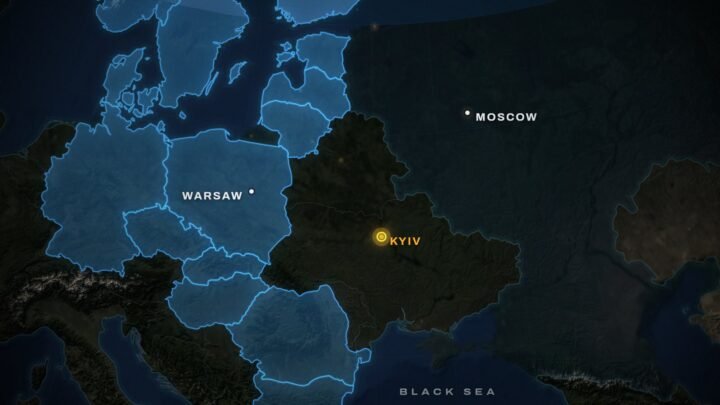
Poland now has more soldiers than any other EU country, by its own count, and its leaders want Europe's largest army. History, geography and the war next door explain why. The bill explains the doubts.

In short
- By its own count, Poland has more than 220,000 soldiers, the most in the European Union, including about 40,000 mostly part-time territorial troops.
- Its goal is 300,000 soldiers plus 200,000 trained reservists: by 2030 in the defence minister's words, by 2039 in the army's own plan.
- Poland plans to spend 4.8% of its GDP on defence in 2026; in 2025, at 4.3%, it had the highest share in NATO.
- Much of the money is borrowed through a fund outside the normal budget, and public debt passed the EU's 60% limit in 2026.
- Warsaw calls the build-up deterrence; Moscow calls it 'accelerated remilitarisation'.
In this analysis 8 sections
- 01Poland army size: how big is it now?
- 02Why is Poland arming? History and geography
- 03The war next door: what has happened on Polish soil?
- 04Poland military spending: what it buys, and who pays
- 05Can Poland count on America?
- 06Europe's new centre of gravity, and how Moscow sees it
- 07What to watch next
- 08Frequently asked questions
On 15 August 2026, Warsaw held the biggest military parade in Polish history by the amount of equipment on show, according to the defence ministry. About 2,000 soldiers marched, around 300 vehicles rolled past and more than 60 aircraft flew over, among them Poland’s new F-35 stealth fighters. Two weeks earlier, by Poland’s account, a Russian cruise missile had come down in a field in the east of the country.
By its own count, Poland’s army now has more than 220,000 soldiers, more than any other country in the European Union. Prime Minister Donald Tusk says it will soon be the largest in Europe. So what is behind the Poland army build-up: why is Poland arming so fast, who is it afraid of, and can it afford it?
Poland army size: how big is it now?
In March 2022, weeks after Russia’s full-scale invasion of Ukraine, the Sejm passed the Homeland Defence Act by 450 votes to none. Poland then had about 143,500 soldiers: roughly 111,500 professionals and 32,000 territorial troops.
By August 2026, the defence ministry counted more than 220,000. That wider count includes about 40,000 territorial soldiers, mostly part-time, plus volunteers in basic service and reservists on duty. Counted like for like, the rise is smaller: to about 196,000.
The goal is 300,000 soldiers plus 200,000 trained reservists. Defence minister Władysław Kosiniak-Kamysz wants that by 2030. The army’s own development programme, which he signed in December 2025, says 2039.
Is it already Europe’s biggest army?
Not yet, and the answer depends on how you count. On Poland’s count, its armed forces are the largest in the EU and the third largest in NATO, after the United States and Turkey. Russia and Ukraine have bigger forces. Counting only full-time soldiers, Poland has about 180,000, roughly level with Germany and below France.
So “Europe’s biggest army” is the government’s goal, not yet a fact. Tusk made the pledge at the naval parade in Gdynia on 15 August: “Our army, our armed forces, will soon be the largest in Europe,” in the Kyiv Independent’s translation.
| Poland’s armed forces | Figure | As of |
|---|---|---|
| Soldiers, Poland’s wider count | 220,000+ (about 40,000 territorial) | August 2026 |
| Soldiers before the 2022 law | about 143,500 | February 2022 |
| Target | 300,000 + 200,000 reservists | 2030 (minister) or 2039 (army plan) |
| Defence spending, share of GDP | 2.2% (2022), 4.3% (2025), 4.8% planned (2026) | NATO; 2026 budget |
| K2 tanks delivered | 208 of 360 ordered | August 2026 |
| Abrams tanks delivered | about 333 of 366 ordered | September 2026 |
| German soldiers, for comparison | about 186,700 | 31 July 2026 |
| US troops in Poland | 6,000 to 10,000 in recent years | 2026 |
Why is Poland arming? History and geography
A country that vanished from the map
Between 1772 and 1795, Russia, Prussia and Austria carved up the Polish-Lithuanian state in three partitions. Poland vanished from the map for 123 years, until 1918. In August 1920, its army defeated the Red Army outside Warsaw. Poland still marks that victory every 15 August, on Armed Forces Day.
In 1939, Germany invaded on 1 September and the Soviet Union on 17 September. A secret protocol between Berlin and Moscow had already split Poland between them. In 1940, Soviet forces killed nearly 22,000 Polish officers, police and others in the Katyn massacre. Moscow blamed Germany for almost 50 years, until 1990.
In 1944, the Warsaw Uprising was crushed after 63 days, while the Red Army halted across the Vistula. Why it gave so little help is still disputed. By 1945, nearly 6 million Polish citizens were dead, about one in six. Poland broke free of Moscow’s control in 1989 and joined NATO in 1999.
The flat road
Except for its southern mountains, Poland lies almost entirely on the North European Plain, at an average height of 173 metres, says Britannica. Its big rivers and the Masurian lakes are the main natural obstacles. So armies have crossed it in both directions: Napoleon’s heading east in 1812, Germany’s in 1941, and the Soviet armies heading west in 1944 and 1945.
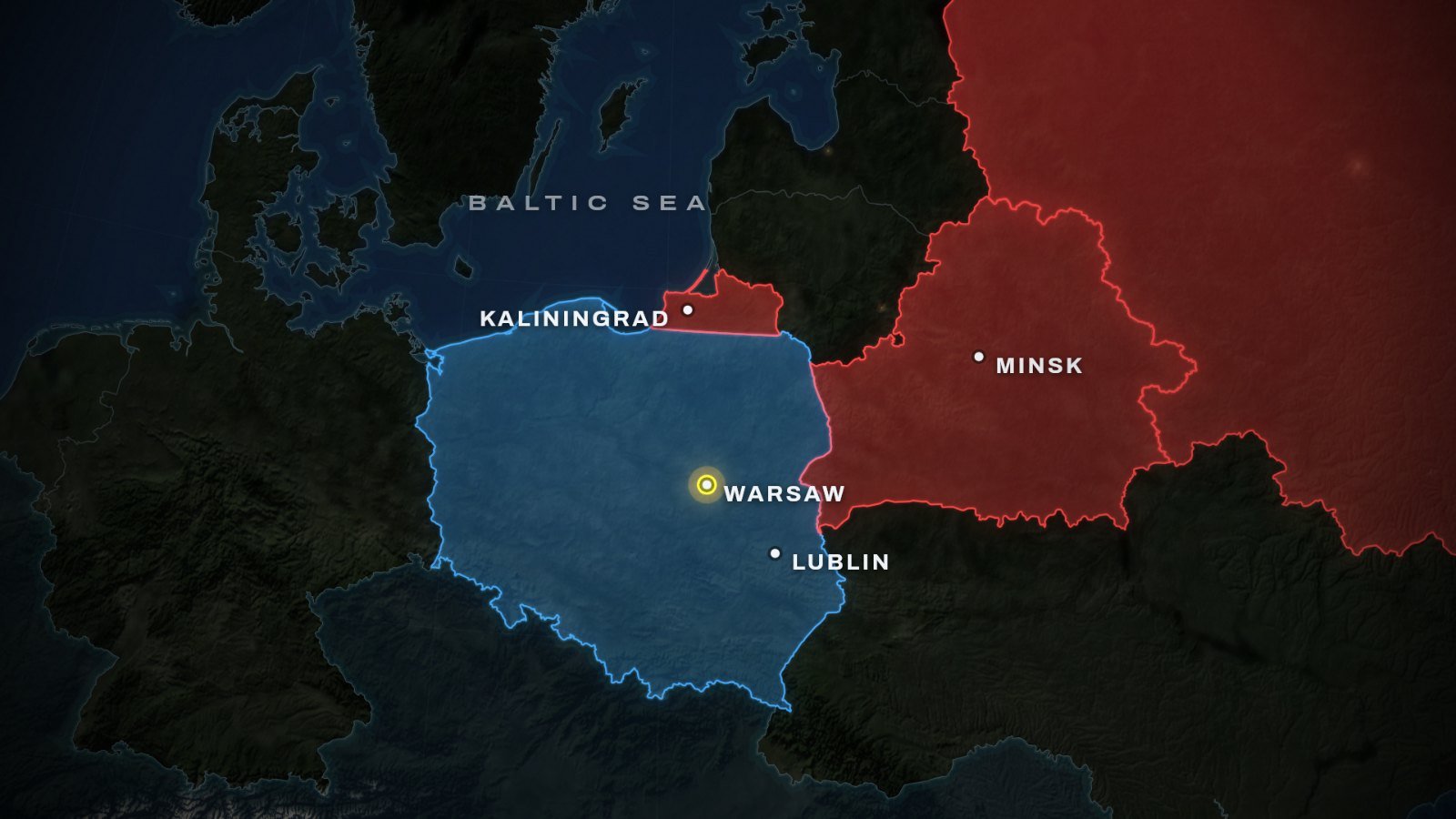
Today, by Poland’s own figures, its borders with Ukraine, Belarus and Russia run for more than 1,100 km. That is 535 km with Ukraine, 418 km with Belarus and 210 km with Russia’s Kaliningrad region. Warsaw is less than 200 km from Belarus.
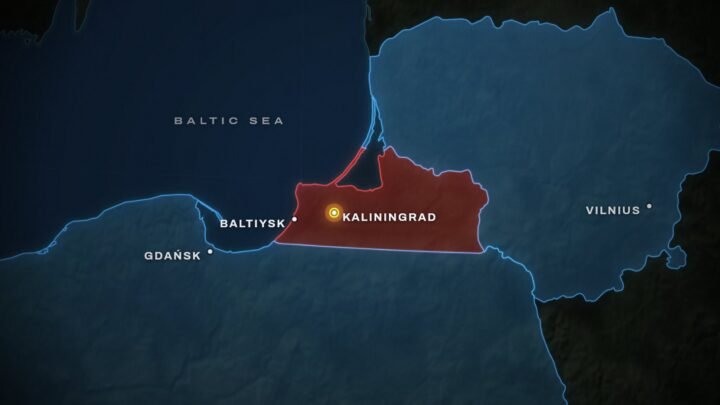
In the north-east, only about 65 km in a straight line separate Kaliningrad from Belarus. That strip is the Suwałki Gap, the only land route between the Baltic states and the rest of NATO. Kaliningrad has a story of its own: why Russia owns Kaliningrad.
The war next door: what has happened on Polish soil?
Since 2022, Poland has been Ukraine’s main gateway to the West. Polish officials say about 90% of international military aid for Ukraine has passed through one airport hub, Rzeszów-Jasionka, in the south-east.
Poland also says it has become a target. The main incidents, with each side’s account:
- The Belarus border, since 2021. Warsaw accuses Minsk and Moscow of organising migrant crossings. Belarus denies it.
- The Marywilska fire, May 2024. Fire destroyed one of Warsaw’s biggest shopping centres. A year later, Tusk said Russian services had ordered the arson.
- The drones, September 2025. During a Russian attack on Ukraine, Poland counted 19 violations of its airspace in one night. Polish and allied jets shot several drones down, and Poland asked NATO for talks under Article 4. Russia’s defence ministry said it had planned no targets in Poland.
- Zapad 2025. As Russia and Belarus held their war games, Poland closed its entire border with Belarus for two weeks.
- The railway blast, November 2025. An explosion wrecked a line carrying aid to Ukraine near Mika, south-east of Warsaw. Tusk blamed people working for Russian services. The Kremlin dismissed the charge as “Russophobia”.
- The missile, 30 July 2026. A cruise missile came down near Tarnawa-Kolonia, in Lublin province. Poland says it was a Russian Kh-101, built near Moscow months earlier, and summoned Russia’s envoy. Tusk said there were no grounds to think Poland was the target.
After the drones, Tusk told parliament it was “the closest we have been to open conflict since World War II”. However, he said he had no reason to claim Poland was on the brink of war.
Poland military spending: what it buys, and who pays
Tanks, jets and people
Poland ordered 360 Korean K2 tanks and 366 American Abrams. By September 2026, 208 K2s and about 333 Abrams had arrived. Also on order are Korean K9 howitzers and Homar-K rocket launchers, 96 Apache helicopters (due from 2028), 32 F-35 fighters (eight are in Poland) and more Patriot batteries.
If deliveries continue, Poland is on course for about 1,100 tanks by 2030, according to projections reported by Euronews. That would be more than Britain, France, Germany and Italy have today, combined. But the total counts about 150 older PT-91 tanks, and the other four are buying tanks too.
NATO put Poland’s defence spending at about 2.2% of GDP in 2022 and 4.3% in 2025, the highest share in the alliance. The 2026 budget plans 4.8%, about PLN 200 billion. NATO’s own estimate for 2026 is 4.68%, fourth in the alliance behind Lithuania, Estonia and Latvia.
In March 2025, Tusk also announced military training for every adult man who wants it, without bringing back conscription.
The bill
Much of the money is borrowed through the Armed Forces Support Fund, run by the state bank BGK outside the normal budget. Defence24 reports that its debt is set to rise from PLN 142 billion at the end of 2026 to PLN 447.5 billion by 2030.
On the EU’s method, which counts the fund, public debt reached 61.6% of GDP in early 2026. That is above the EU’s 60% limit for the first time in three decades, and the deficit is heading for about 7%. In September, Moody’s cut Poland’s rating from A2 to A3, naming “high defense expenditure” among four pressures. Poland’s own Supreme Audit Office (NIK) has called the fund faultily designed and a threat.
Poland also took the largest share of the EU’s new SAFE defence loans: €43.7 billion. In March 2026, President Karol Nawrocki vetoed the law to spend them, saying the loans threatened Poland’s sovereignty. The government routed the money around the veto and signed the loan in May. The president’s office calls that route inadmissible.
The bottlenecks
- People. 9,168 professional soldiers left in 2023 and 9,282 in 2024, as the army struggled to match private pay. Even so, retention in 2025 was the best in 25 years, the General Staff says.
- Quality. A Polish defence analyst reported engine and suspension faults in some K2 tanks. The Armament Agency says the failure rate is normal for new equipment.
- Industry. Only 61 of the 360 K2s will be assembled in Poland, with the engine and fire control reportedly still made in Korea.
And Ukraine’s war raises a harder question. In an age of cheap drones, how many tanks does a country need?
Can Poland count on America?
Many of Poland’s new weapons are American. Between 6,000 and 10,000 US troops have been in Poland in recent years, mostly on rotation. Poland wants about 15,000 and a permanent American base.
Washington’s signals have been mixed. In June 2025, asked whether he would honour NATO’s mutual defence clause, President Donald Trump said: “Depends on your definition.” In May 2026, the Pentagon halted a planned rotation of about 4,000 troops to Poland. A week later, Trump said he would send 5,000 more.
In September, Trump spoke of “major progress” toward a US Army base in Poland. As of mid-October, no site has been announced. On 2 October, deputy defence minister Cezary Tomczyk put the US presence at about 7,000, TASS reported. Meanwhile, a Pentagon review of US forces in Europe is due in December.
Tusk put Europe’s dependence in one line in March 2025:
500 million Europeans are asking 300 million Americans to protect us from 140 million Russians.
Donald Tusk, 2 March 2025 (translated)
Kosiniak-Kamysz describes Poland’s answer as three pillars: a strong society, a strong army and strong alliances.
Europe’s new centre of gravity, and how Moscow sees it
For centuries, bigger armies marched across Poland. Now, by its own count, Poland has more soldiers than Germany, which had about 186,700 in July 2026. Poland’s figure includes territorial troops, though, and Germany spends nearly three times as much, on NATO’s estimates. Still, on Poland’s count, the EU’s biggest armed forces now stand on its eastern edge.
Moscow reads this differently. Russia’s foreign ministry spokeswoman, Maria Zakharova, has called Poland’s Army Day parade a showcase of “accelerated remilitarisation”. In May 2026, she warned that moving more US forces to Poland would force “military-technical measures” and could bring “a qualitative escalation”. Poland’s foreign ministry called the warning groundless.
In October 2025, Vladimir Putin called fears of a Russian attack on NATO “nonsense”, while warning of a response to Europe’s “militarisation”. Moscow’s wider objection to NATO’s growth is the subject of why Russia doesn’t want Ukraine in NATO. The northern end of the same frontier is covered in why Russia is massing troops on Finland’s border.
Warsaw’s answer came on 28 January 2026. Kosiniak-Kamysz told foreign military attachés that the point of the build-up is that no one ever thinks of attacking Poland or NATO. “Peace needs strength to defend itself,” his ministry reported. So the same army looks like two things: deterrence to Warsaw, remilitarisation on Russia’s doorstep to Moscow.
What to watch next
- The money. The draft budget for 2027 puts defence at PLN 198.1 billion, or 4.51% of GDP, slightly below 2026. Defence24 analyst Jakub Palowski warns the hardest years may come after 2030, when the EU loans run out.
- America’s review. Watch whether a US base in Poland gets a site, and whether troop numbers return to about 10,000.
- People. Can Poland really reach 300,000 soldiers by 2030, or even by 2039?
- The war next door. On 12 October 2026, Russia struck Ukrainian energy facilities hours after Trump announced an energy ceasefire, AP reported.
Read more analysis on Europe.
Frequently asked questions
How big is the Polish army in 2026?
By the defence ministry’s count, Poland has more than 220,000 soldiers as of August 2026, including about 40,000 mostly part-time territorial troops. That is the most in the European Union and the third most in NATO, after the United States and Turkey. Counting only full-time soldiers, the figure is about 180,000.
How much does Poland spend on its military?
Poland’s 2026 budget plans 4.8% of GDP for defence, about PLN 200 billion. NATO estimates 4.68%, fourth in the alliance behind the three Baltic states. In 2025, at 4.3%, Poland had NATO’s highest share. The government’s draft for 2027 keeps defence at about 4.5% of GDP.
Does Poland have the largest army in Europe?
Not yet. Russia and Ukraine have bigger forces, and within NATO so does Turkey. By its own count, which includes territorial troops, Poland has the largest armed forces in the EU. Prime Minister Donald Tusk says Poland will soon have the largest army in Europe, but that is still a goal.
Why is Poland building up its army?
Polish leaders point to Russia’s war in Ukraine, incidents on Polish soil they blame on Russia, and doubts about American support. History weighs too: Poland vanished from the map from 1795 to 1918 and was invaded from both sides in 1939. Warsaw calls the build-up deterrence; Moscow calls it remilitarisation.
How many US troops are in Poland?
Between 6,000 and 10,000 American troops have been in Poland in recent years, mostly on rotation. On 2 October 2026, a Polish deputy defence minister put the figure at about 7,000, after the Pentagon halted a planned rotation in May. Poland wants about 15,000 and a permanent US base.
How many tanks does Poland have?
By September 2026, Poland had received 208 of 360 Korean K2 tanks and about 333 of 366 American Abrams, alongside older tanks. If deliveries continue, it is on course for about 1,100 tanks by 2030. That would be more than Britain, France, Germany and Italy have today, combined, according to projections reported by Euronews.
Sources
- Poland will soon have Europe's largest army, Tusk pledges
- Poland's military reaches 220,000 active personnel
- Polish army grows to around 220,000 soldiers
- More troops and more money for defence: the Council of Ministers adopted a draft Homeland Defence Act
- Poland targets 500,000 troops by 2039 under new military plan
- Five NATO members seen to spend over 3.5% of GDP on core defence this year, alliance estimates (Reuters)
- Poland records highest NATO defence spending share in 2025
- By 2030, Poland will have more tanks than the UK, Germany, France and Italy combined
Show all 45 sources
- Statement on summoning the Ambassador of the Russian Federation to the MFA
- Poland protests to Russian ambassador over missile incursion
- Poland records 19 airspace violations, Tusk says
- Poland says 2 Ukrainians working for Russia are suspected in weekend railway track explosion (AP)
- Pentagon halts deployments to Poland and Germany (AP)
- Trump touts major progress towards setting up US military base in Poland
- Poland wants 15,000 US troops
- Pentagon has kicked off review of US force posture in Europe
- Moody's rating agency downgraded Poland's credit rating
- Poland's debt climbs above 500bn as borrowing reaches record pace
- Fundusz Wsparcia Sił Zbrojnych: wadliwie zaprojektowany i stwarzający zagrożenie
- Poland signs €43.7bn EU defence loan
- Personalzahlen der Bundeswehr auf neuem Höchststand
- Putin warns of harsh response to Europe's militarisation
- US troop withdrawal from Europe would be 'rational, long overdue step' for stability: Russia
- Deputy Prime Minister W. Kosiniak-Kamysz: we will always watch over building strength, security and peace
- Remembering Katyn
- Poland: Land
- Budżet obronny lekko spada, najgorsze dopiero przed nami
- Rząd przyjął projekt budżetu na 2027 rok
- Sejm uchwalił ustawę o obronie Ojczyzny
- Polish deputy PM: aid hub in Jasionka restores normal rhythm of operations
- Poland and Belarus border crisis
- Poland says Russian secret service behind 2024 fire in Warsaw shopping centre (Reuters)
- Poland has closed its border with Belarus
- Tusk tells Polish parliament that military conflict with Russia closer than at any time since WWII
- Poland says it plans to give every adult male military training
- We're with them all the way: amid worry, Trump renews American defense of NATO
- Trump says US will send an additional 5,000 troops to Poland
- About 7,000 US troops in Poland, deputy defence minister says
- Tusk: 500 million Europeans ask 300 million Americans to protect them from 140 million Russians
- Ilu żołnierzy przychodzi i odchodzi z wojska: MON ujawnia dane z dekady
- Problemy czołgów K2: Agencja Uzbrojenia odpowiada
- Poland signs $6.5bn tank deal with Hyundai Rotem
- NATO defence spending projected to top $1.8 trillion in 2026
- Zelenskyy says Russia strikes energy facilities despite Trump claim of an energy ceasefire (AP)
- The Republic of Poland in the face of the Second World War
Facts as of 15 October 2026. Spotted a mistake? Tell us, and we will correct it.